Triethylamine → 2-[[(1,1-Dimethylethoxy)carbonyl]amino]ethyl 2,4,6-trimethylbenzenesulfonate
Reaction equation

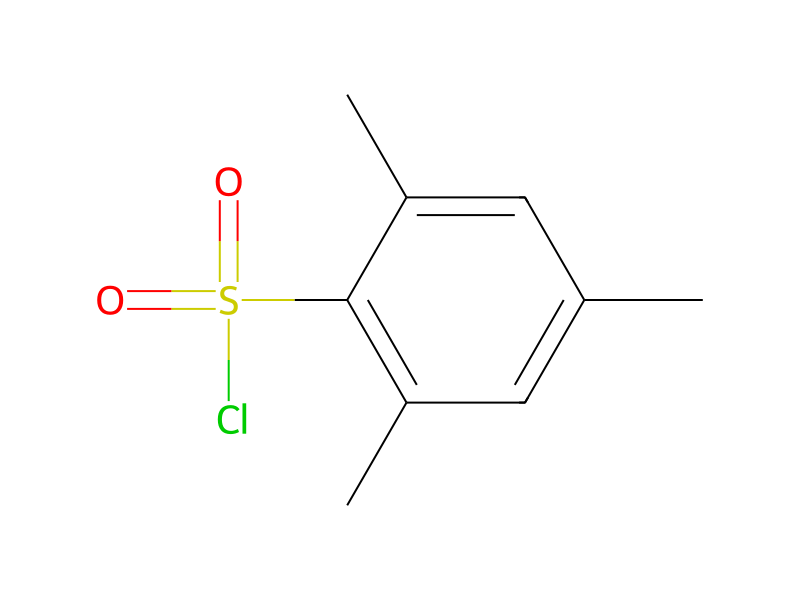
C(N(CC)CC)C.[OH:8][CH2:9][CH2:10][NH:11][C:12](=[O:18])[O:13][C:14]([CH3:17])([CH3:16])[CH3:15].Cl.CN(C)C.[C:24]1([CH3:36])[CH:29]=[C:28]([CH3:30])[CH:27]=[C:26]([CH3:31])[C:25]=1[S:32](Cl)(=[O:34])=[O:33]>ClCCl.O>[CH3:36][C:24]1[CH:29]=[C:28]([CH3:30])[CH:27]=[C:26]([CH3:31])[C:25]=1[S:32]([O:8][CH2:9][CH2:10][NH:11][C:12]([O:13][C:14]([CH3:15])([CH3:17])[CH3:16])=[O:18])(=[O:33])=[O:34]Participants
Reactant 4



Product 1

Reagents, catalysts & solvents 2


Conditions
- Temperature
- -10 °C
Procedure
Triethylamine (65 mL, 465.3 mmole, 1.5 eq) was added in one portion to a solution of tert-butyl N-(2-hydroxyethyl)carbamate (50.11 g, 310.2 mmole, 1.0 eq.) in dichloromethane (250 mL, 5 vols). The solution was cooled to −10° C. and trimethylamine hydrochloride (14.84 g, 155.1 mmole, 0.5 eq.) was added in one portion. The resultant mixture was cooled further to −15° C., stirred for 5 minutes, then treated with a solution of mesitylenesulfonyl chloride (74.74 g, 341.2 mmole, 1.1 eq) in dichloromethane (250 mL, 5 vols), over 28 minutes such that the internal temperature remained below −10° C. Once the addition was complete a precipitate had formed and the mixture was stirred at −10° C. for a further 30 minutes. Water (400 mL, 8 vols) was added and all of the precipitate dissolved. The mixture was stirred rapidly for 5 minutes, and then the two layers were separated. A solvent swap from dichloromethane to isopropanol was carried out by distillation at reduced pressure. Solvent was removed (450 mL) and replaced with iso-propanol (450 mL (initial pressure was 450 mbar, b.p. 24° C.; final pressure was 110 mbar, b.p. 36° C.). At the end of the distillation, solvent (150 mL) was removed to bring the volume down to 350 mL (7 vols with respect to the amount of tert-butyl N-(2-hydroxyethyl)carbamate used). The solution was cooled to 25° C., then water (175 mL) was added slowly with stirring, causing the solution gradually to turn cloudy. No solid had precipitated at this stage. More water (125 mL) was added, and a solid precipitate started to form after about 75 mL had been added. The internal temperature rose from 25° C. to 31° C. The mixture was stirred slowly and cooled to 7° C. The solid was collected by filtration, washed with iso-propanol:water (1:1, 150 mL) and dried in vacuo at 40° C. for 21 hours to give the sub-title compound as a white crystalline solid (92.54 g, 87%).
Workup
- customremained below −10° C
- additionOnce the addition
- customhad formed
- stirringthe mixture was stirred at −10° C. for a further 30 minutes
- dissolutionall of the precipitate dissolved
- stirringThe mixture was stirred rapidly for 5 minutes
- customthe two layers were separated
- distillationA solvent swap from dichloromethane to isopropanol was carried out by distillation at reduced pressure
- customSolvent was removed (450 mL)
- distillationAt the end of the distillation, solvent (150 mL)
- customwas removed
- temperatureThe solution was cooled to 25° C.
- additionwater (175 mL) was added slowly
- stirringwith stirring
- customNo solid had precipitated at this stage
- additionMore water (125 mL) was added
- customto form after about 75 mL
- additionhad been added
- customrose from 25° C. to 31° C
- stirringThe mixture was stirred slowly
- temperaturecooled to 7° C
- filtrationThe solid was collected by filtration
- washwashed with iso-propanol:water (1:1, 150 mL)
- customdried in vacuo at 40° C. for 21 hours
Sources & evidence
- ORD record
- ord-d09311323cbe4cb7b5d3fe77bf072560
- Source dataset
- uspto-grants-2007_05
- Patent number
- US07217708B2
Reaction notes
Loading…