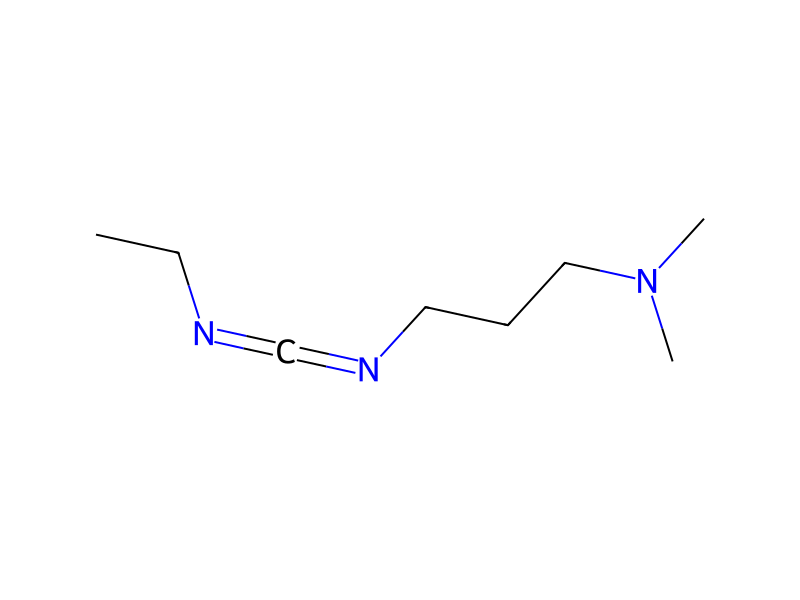
1-Ethyl-3-(3'-dimethylaminopropyl)carbodiimide → 2,5-Dioxopyrrolidin-1-yl 4-bromo-2-chlorobenzoate
Reaction equation

[Br:1][C:2]1[CH:10]=[CH:9][C:5]([C:6]([OH:8])=[O:7])=[C:4]([Cl:11])[CH:3]=1.O[N:13]1[C:17](=[O:18])[CH2:16][CH2:15][C:14]1=[O:19].CCN=C=NCCCN(C)C>O1CCCC1.CN(C)C=O>[Br:1][C:2]1[CH:10]=[CH:9][C:5]([C:6]([O:8][N:13]2[C:17](=[O:18])[CH2:16][CH2:15][C:14]2=[O:19])=[O:7])=[C:4]([Cl:11])[CH:3]=1Participants
5
Reactant 3


Product 1

Reagents, catalysts & solvents 1

Procedure
A solution of 4-bromo-2-chlorobenzoic acid (2.00 g, 8.5 mmol), N-hydroxysuccinimide (1.07 g, 9.3 mmol) and EDCI (1.79 g, 9.3 mmol) in tetrahydrofuran/N,N-dimethylformamide (3:1; 40 Ml) was stirred at room temperature for 18 h. The reaction was concentrated and water (50 Ml) was added. The mixture was extracted with ethyl acetate (3×50 Ml) and the combined organic layers were washed with brine, dried (Na2SO4), concentrated, and dried in vacuo to give 1-[(4-bromo-2-chlorobenzoyl)oxy]-2,5-pyrrolidinedione (2.59 g, 92%) as an off-white solid which was used directly in the next step without further purification.
Workup
- concentrationThe reaction was concentrated
- additionwater (50 Ml) was added
- extractionThe mixture was extracted with ethyl acetate (3×50 Ml)
- washthe combined organic layers were washed with brine
- dry with materialdried (Na2SO4)
- concentrationconcentrated
- customdried in vacuo
Sources & evidence
- ORD record
- ord-f528edf8f9ec48b5abb8dd74c184948c
- Source dataset
- uspto-grants-2007_05
- Patent number
- US07217728B2
Reaction notes
Loading…