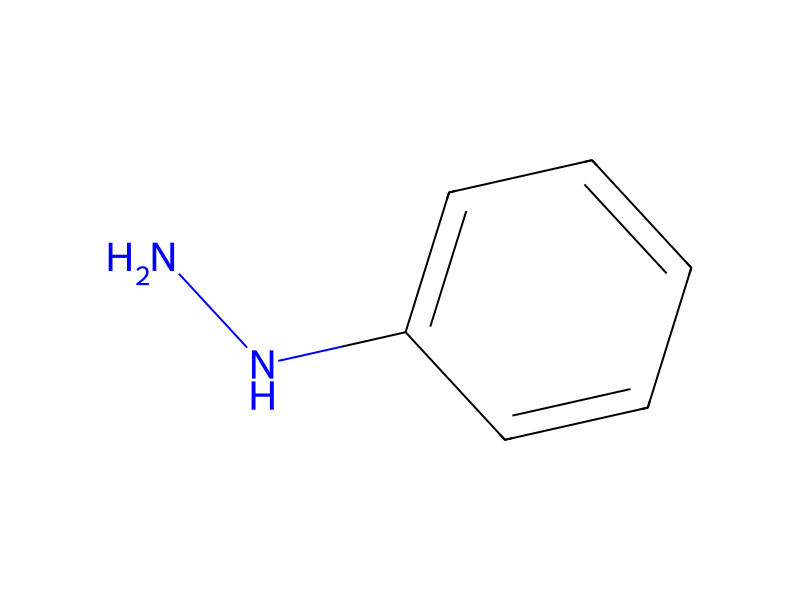
Phenylhydrazine → HCID 69410039, compound
Reaction equation

[CH2:1]1[CH2:9][O:8][C:7]2[C:3](=[C:4]([CH:10]=O)[S:5][CH:6]=2)[O:2]1.[C:12]1([NH:18][NH2:19])[CH:17]=[CH:16][CH:15]=[CH:14][CH:13]=1>CO>[C:12]1([NH:18][N:19]=[CH:10][C:4]2[S:5][CH:6]=[C:7]3[O:8][CH2:9][CH2:1][O:2][C:3]=23)[CH:17]=[CH:16][CH:15]=[CH:14][CH:13]=1Participants
Reactant 2

Product 1

Reagents, catalysts & solvents 1

Conditions
- Temperature
- 65 °C
Procedure
In a 250 ml round bottomed flask, 3,4-ethylenedioxythiophene-2-carbaldehyde (5 g, 0.0294 mol) was dissolved in 120 ml of methanol by heat. A solution of N-phenylhydrazine (4.76 g, 0.0441 mol) in methanol was added to the cooled reaction mixture. After the reaction mixture was heated at 65° C. for 2.5 hours, the reaction mixture was concentrated and then placed in a freezer to form yellowish crystals of 3,4-ethylenedioxythiophene-2-carbaldehyde N-phenylhydrazone. The yellowish crystals were filtered off, washed with a large amount of cold methanol, and dried. The yield of 3,4-ethylenedioxythiophene-2-carbaldehyde N-phenylhydrazone was 4.73 g (62%). The melting point of the product was found to be 136–137° C. The 1H-NMR spectrum (100 MHz) of the product in CDCl3 was characterized by the following chemical shifts (δ, ppm): 7.81 (s, 1H, CH═N), 7.4–6.95 (m, 4H, Ar), 6.82 (t, 1H, J=5.3 Hz, 4-HPh), 6.26 (s, 1H, CH═S), and 4.4–4.1 (m, 4H, OCH2CH2). The infrared absorption spectrum of the product was characterized by the following absorption peaks (KBr window, cm−1): 3124, 3058 (arene C—H); 2976, 2922, 2869 (CH); 1595, 1500, 1442 (C═C in Ar, C═N); 1069, 935, 907 (C—O); 760 (Ar). The mass spectrum of the product was characterized by the following m/z peak: 261 (100%, M+1).
Workup
- temperatureby heat
- concentrationthe reaction mixture was concentrated
Sources & evidence
- ORD record
- ord-b489bdba1d3d4cfeb8ba037191624de4
- Source dataset
- uspto-grants-2007_05
- Patent number
- US07220523B2
Reaction notes
Loading…