Ethanol → HCID 86585349, compound
Reaction equation

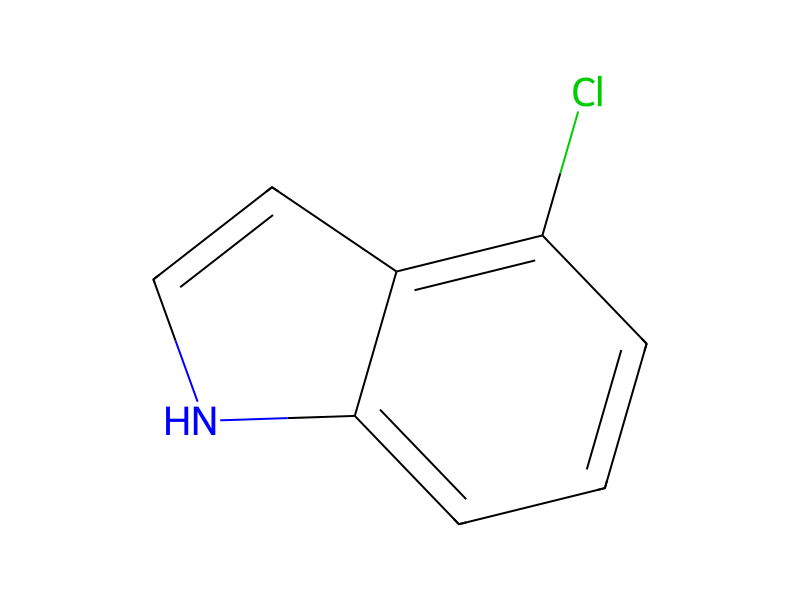
[Cl:1][C:2]1[CH:10]=[CH:9][CH:8]=[C:7]2[C:3]=1[CH:4]=[CH:5][NH:6]2.[C:11](Cl)(=[O:15])[C:12](Cl)=[O:13].[CH3:17][CH2:18][OH:19]>>[Cl:1][C:2]1[CH:10]=[CH:9][CH:8]=[C:7]2[C:3]=1[CH:4]=[C:5]([C:11](=[O:15])[C:12]([O:19][CH2:18][CH3:17])=[O:13])[NH:6]2Participants



Procedure
Intermediate compounds of Formula (IV) can be prepared by the reaction scheme depicted in FIG. 22. Acylation of 4-chloroindole (64) (oxalyl chloride, followed by an EtOH quench) provides an ethyl 4-chloroindole glyoxalate (65), which is reduced (e.g., LiAlH4) to the 4-chloroindole-3-ethanol (66). Substitution of the alcohol (66) is achieved using a suitable azide, such as Zn(N3)2, under Mitsunobu reaction conditions to provide (67). Malonate addition to (67) is accomplished as described by Kuehne J. Org. Chem., 63, 9427 (1998), to provide a malonyl enolate (68). Alkylation of the malonyl enolate (68) with a suitable alkylating agent such as NaOMe and Mel, provides (69). The azide group of (69) is reduced (sequential addition of PMe3 and H2O) to provide an aminoester (70). The aminoester (70) undergoes intramolecular cyclization, providing lactam (71) upon reflux as a solution in MeOH. Racemate (71) is separated into the enantiomers (72) and (73) by chiral support chromatography. The assignment of the absolute configurations to (72) and (73) is made by x-ray crystallographic analysis. The lactam group of each enantiomer is separately reduced (BH3) to provide amines (74) (from reduction of (72)) and (75) (from reduction of (73)), which may be formulated as the fumarate salts.
Workup
- customquench)
Sources & evidence
- ORD record
- ord-2874c2273252456b9c28cf5ce7c56610
- Source dataset
- uspto-grants-2003_07
- Patent number
- US06586421B2
Reaction notes
Loading…