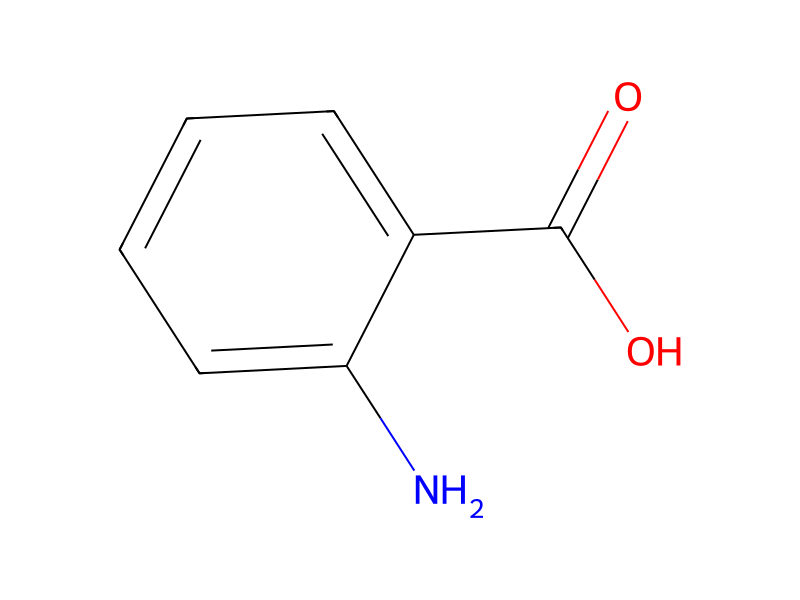
Anthranilic Acid → HCID 18186421, compound
Reaction equation

[NH2:1][C:2]1[CH:10]=[CH:9][CH:8]=[CH:7][C:3]=1[C:4](O)=O.[CH3:11][CH:12]1[CH2:17][CH2:16][C:15](=O)[CH2:14][CH2:13]1.P(Cl)(Cl)([Cl:21])=O>>[Cl:21][C:4]1[C:3]2[C:2]([N:1]=[C:15]3[C:16]=1[CH2:17][CH:12]([CH3:11])[CH2:13][CH2:14]3)=[CH:10][CH:9]=[CH:8][CH:7]=2Participants



Procedure
1.37 g (10 mmol) of 2-aminobenzoic acid and 1.23 ml (10 mmol) of 4-methylcyclohexanone were dissolved in 10 ml of phosphorus oxychloride and the reaction mixture was heated under reflux in a nitrogen atmosphere. After 3 h most of the phosphorus oxychloride was removed under vacuum. The remaining brown syrup was poured into a cold sodium bicarbonate (sat.) solution and washed once with chloroform. The yellow precipitate forming in the basic water solution was filtered (2-methyl-1,2,3,4-tetrahydro-9-(10H)-acridone, 46%). Following the procedure of Step 3 in Example 1, but substituting 2-methyl-1,2,3,4-tetrahydro-9-(10H)acridone for 9-(10H)acridone, gave 9-chloro-2-methyl-1,2,3,4-tetrahydroacridine (40%), which was reacted with 4-(4-methylpiperazin-1-yl)aniline (according to the procedure of Step 4 in Example 1), to afford the title compound with 39% yield (overall yield 7%).
Workup
- temperaturethe reaction mixture was heated
- temperatureunder reflux in a nitrogen atmosphere
- customAfter 3 h most of the phosphorus oxychloride was removed under vacuum
- additionThe remaining brown syrup was poured into a cold sodium bicarbonate (sat.) solution
- washwashed once with chloroform
- customThe yellow precipitate forming in the basic water solution
- filtrationwas filtered (2-methyl-1,2,3,4-tetrahydro-9-(10H)-acridone, 46%)
Sources & evidence
- ORD record
- ord-4a7909b8c8c941a890b0cda3ae7809f3
- Source dataset
- uspto-grants-2003_07
- Patent number
- US06593324B2
Reaction notes
Loading…