Hydrochloric Acid → 2-(trimethylsilyl)ethyl N-[(allyloxy)carbonyl]-L-norleucyl-(4R)-4-[(2-phenyl-6-vinylquinolin-4-yl)oxy]-L-prolinate
Reaction equation

[C:1]1([C:7]2[CH:16]=[C:15]([O:17][C@H:18]3[CH2:22][N:21](C(OC(C)(C)C)=O)[C@H:20]([C:30]([O:32][CH2:33][CH2:34][Si:35]([CH3:38])([CH3:37])[CH3:36])=[O:31])[CH2:19]3)[C:14]3[C:9](=[CH:10][CH:11]=[C:12]([CH:39]=[CH2:40])[CH:13]=3)[N:8]=2)[CH:6]=[CH:5][CH:4]=[CH:3][CH:2]=1.Cl.O1CCOCC1.[CH2:48]([O:51][C:52]([NH:54][C@H:55]([C:60](O)=[O:61])[CH2:56][CH2:57][CH2:58][CH3:59])=[O:53])[CH:49]=[CH2:50].CCN(C(C)C)C(C)C.CN(C(ON1N=NC2C=CC=CC1=2)=[N+](C)C)C.[B-](F)(F)(F)F>>[CH2:48]([O:51][C:52]([NH:54][C@H:55]([C:60]([N:21]1[CH2:22][C@H:18]([O:17][C:15]2[C:14]3[C:9](=[CH:10][CH:11]=[C:12]([CH:39]=[CH2:40])[CH:13]=3)[N:8]=[C:7]([C:1]3[CH:6]=[CH:5][CH:4]=[CH:3][CH:2]=3)[CH:16]=2)[CH2:19][C@H:20]1[C:30]([O:32][CH2:33][CH2:34][Si:35]([CH3:38])([CH3:37])[CH3:36])=[O:31])=[O:61])[CH2:56][CH2:57][CH2:58][CH3:59])=[O:53])[CH:49]=[CH2:50]Participants
Reactant 6
 HCID 313Hydrochloric Acid
 HCID 312751,4-Dioxane
 HCID 81531Diisopropylethylamine
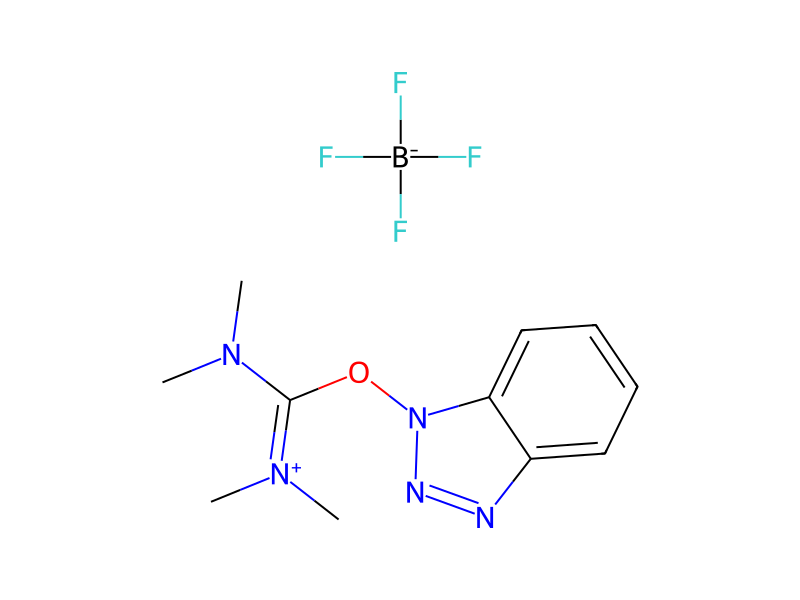 HCID 2733207O-(Benzotriazol-1-yl)-N,N,N',N'-tetramethyluronium tetrafluoroborate
 HCID 51340333(2S)-2-{[(prop-2-en-1-yloxy)carbonyl]amino}hexanoic acid
 HCID 576171271-tert-butyl 2-[2-(trimethylsilyl)ethyl] (2S,4R)-4-[(2-phenyl-6-vinylquinolin-4-yl)oxy]pyrrolidine-1,2-dicarboxylate
Product 1

Procedure
To a flask containing 1-tert-butyl 2-[2-(trimethylsilyl)ethyl] (2S,4R)-4-[(2-phenyl-6-vinylquinolin-4-yl)oxy]pyrrolidine-1,2-dicarboxylate 5 (45 mg, 0.08 mmol) was added a 4 M solution of HCl in dioxane (1.4 mL, 5.6 mmol). After 1 h, LC-MS analysis indicated complete consumption of the starting material (5) and formation of the desired -Boc product. The volatile components were then removed in vacuo, and the crude material was taken up in DMF (1 mL). To this mixture was added alloc-Nle-OH (4) (26 mg, 0.12 mmol), DIPEA (0.144 mL, 0.8 mmol), and TBTU (39 mg, 0.12 mmol). After stirring at RT for 30 min, complete consumption of the amine was evidenced via LC-MS. The reaction mixture was then worked-up with 1N HCl and EtOAc. The organic layer was washed with brine and dried over MgSO4. The solvent was then removed in vacuo and the crude product was purified on silica (10-50% EtOAc/hexanes) to yield 50 mg (95% yield) of 2-(trimethylsilyl)ethyl N-[(allyloxy)carbonyl]-L-norleucyl-(4R)-4-[(2-phenyl-6-vinylquinolin-4-yl)oxy]-L-prolinate 6. 1H NMR (500 MHz, CDCl3) ppm: mixture of amide rotamers: 8.07 (m, 3H), 7.97 (br s, 1H), 7.88 (m, 1H), 7.54-7.47 (m, 3H), 7.07 (s, 1H), 6.92 (dd, J=17.5 Hz, 10.5 Hz, 1H), 5.90 (d, J=17.5 Hz, 1H), 5.83 (m, 1H), 5.43-5.63 (m, 3H), 5.25-5.13 (m, 2H), 4.79 (app t, J=8 Hz, 1H), 4.65-4.37 (m, 4H), 4.26 (m, 2H), 4.10 and 4.08 (2 d, J=4.0 Hz and 4.5 Hz, 1H), 2.78 (m, 1H), 2.42 (m, 1H), 1.83 (m, 1H), 1.63 (m, 1H), 1.44-1.33 (m, 4H), 1.05-0.98 (m, 2H), 0.92 (m, 3H), 0.05 (s, 9H). LRMS (CI, [M+H]) Calc'd=658.4. Found=658.4. HRMS (APCI, [M+H]+) Calc'd for C37H48N3O6Si: 658.3307. found: 658.3348.
Workup
- customconsumption of the starting material (5) and formation of the desired -Boc product
- customThe volatile components were then removed in vacuo
- customcomplete consumption of the amine
- washThe organic layer was washed with brine
- dry with materialdried over MgSO4
- customThe solvent was then removed in vacuo
- customthe crude product was purified on silica (10-50% EtOAc/hexanes)
Sources & evidence
- ORD record
- ord-a9ed8cf7488e44dc8fbea3cafedb7570
- Source dataset
- uspto-grants-2011_02
- Patent number
- US07879797B2
Reaction notes
Loading…