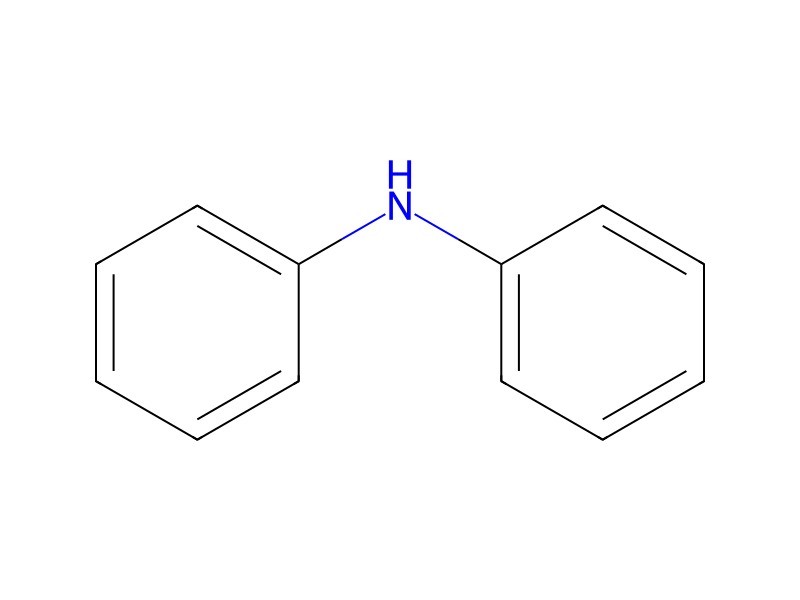
Diphenylamine → N~3~,N~3~,N~6~,N~6~,9-Pentaphenyl-9H-carbazole-3,6-diamine
Reaction equation

[C:1]1([N:7]2[C:19]3[CH:18]=[CH:17][C:16](Br)=[CH:15][C:14]=3[C:13]3[C:8]2=[CH:9][CH:10]=[C:11](Br)[CH:12]=3)[CH:6]=[CH:5][CH:4]=[CH:3][CH:2]=1.[C:22]1([NH:28][C:29]2[CH:34]=[CH:33][CH:32]=[CH:31][CH:30]=2)[CH:27]=[CH:26][CH:25]=[CH:24][CH:23]=1>>[C:29]1([N:28]([C:4]2[CH:5]=[CH:6][C:1]3[N:7]([C:8]4[CH:13]=[CH:12][CH:11]=[CH:10][CH:9]=4)[C:16]4[C:17]([C:2]=3[CH:3]=2)=[CH:18][C:19]([N:7]([C:1]2[CH:2]=[CH:3][CH:4]=[CH:5][CH:6]=2)[C:8]2[CH:9]=[CH:10][CH:11]=[CH:12][CH:13]=2)=[CH:14][CH:15]=4)[C:22]2[CH:23]=[CH:24][CH:25]=[CH:26][CH:27]=2)[CH:30]=[CH:31][CH:32]=[CH:33][CH:34]=1Participants


Procedure
In the present embodiment, raw materials, 12.03 g (30 mmol) of N-phenyl-3,6-dibromocarbazole and 12.18 g (72 mmol) of diphenylamine are used to obtain 3,6-bis(N,N-diphenylamino)-9-phenylcarbazole (hereinafter, referred to as PhCzP2), that is the carbazole derivative represented by the above structural formula (76), in the same way as in Embodiment 2 described above. The obtained PhCzP2 is purified by sublimation at a higher temperature of 270° C. and a lower temperature of 175° C. The yield after the sublimation purification is approximately 50%. FIG. 21 shows a 1H NMR spectrum of the obtained PhCzP2, FIG. 22 shows a 13C NMR spectrum of the obtained PhCzP2, and FIG. 23 shows an enlarged view of a region (A) surrounded by a dashed line in FIG. 22. In FIGS. 21 to 23, a longitudinal axis indicates relative intensity of signals, and a lateral axis indicates the dimensionless value δ which is the difference of resonant frequency between a sample and an authentic sample divided by frequency of an oscillator. Data of 1H NMR and 13C NMR of the obtained PhCzP2 is as follows:
Sources & evidence
- ORD record
- ord-ef960653f9c340e1b9510cab7a36648a
- Source dataset
- uspto-grants-2011_02
- Patent number
- US07892657B2
Reaction notes
Loading…