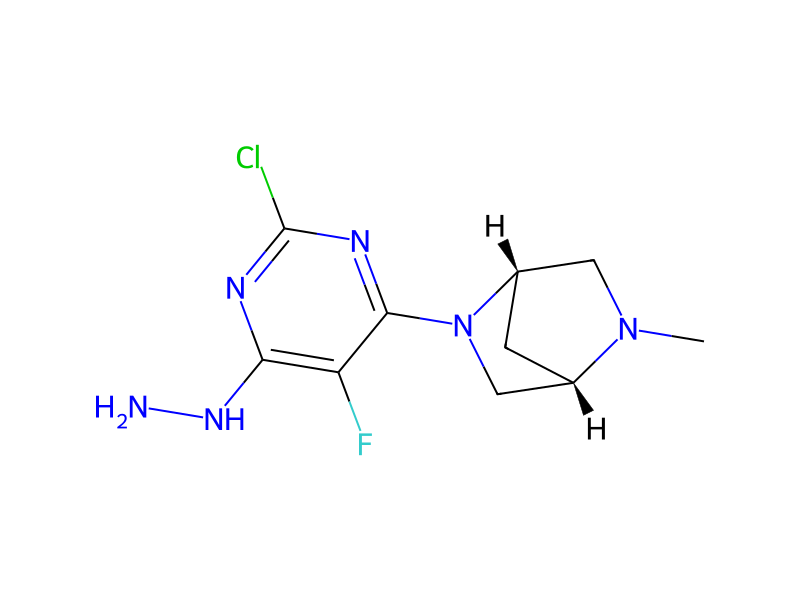
Hydrazine → (1S,4S)-2-(2-chloro-5-fluoro-6-hydrazino-4-pyrimidinyl)-5-methyl-2,5-diazabicyclo[2.2.1]heptane
Reaction equation

[Cl:1][C:2]1[N:7]=[C:6](Cl)[C:5]([F:9])=[C:4](Cl)[N:3]=1.Br.Br.[CH3:13][N:14]1[CH2:19][C@@H:18]2[CH2:20][C@H:15]1[CH2:16][NH:17]2.CCN(C(C)C)C(C)C.[NH2:30][NH2:31]>CS(C)=O>[Cl:1][C:2]1[N:7]=[C:6]([N:17]2[CH2:16][C@@H:15]3[CH2:20][C@H:18]2[CH2:19][N:14]3[CH3:13])[C:5]([F:9])=[C:4]([NH:30][NH2:31])[N:3]=1Participants
Reactant 4




Product 1
Reagents, catalysts & solvents 1

Procedure
2,4,6-Trichloro-5-fluoropyrimidine (2.01 g, 10 mmol) was dissolved in 30 mL of DMSO and stirred at room temperature. Commercially-available (1S,4S)-2-methyl-2,5-diazabicyclo[2.2.1]heptane, dihydrobromide (2.74 g, 10 mmol) was added, followed by DIPEA (5.51 mL, 32 mmol). The resulting reaction mixture was stirred for 2.5 h, and then hydrazine was added (3.0 mL) and the contents were stirred at room temperature overnight. The reaction mixture was then purified by RP-HPLC to provide the assumed (1S,4S)-2-(2-chloro-5-fluoro-6-hydrazino-4-pyrimidinyl)-5-methyl-2,5-diazabicyclo[2.2.1]heptane (first eluent), as well as the assumed 4-chloro-5-fluoro-6-[(1S,4S)-5-methyl-2,5-diazabicyclo[2.2.1]hept-2-yl]-2(1H)-pyrimidinone hydrazone (second eluent).
Workup
- customThe resulting reaction mixture
- stirringwas stirred for 2.5 h
- stirringthe contents were stirred at room temperature overnight
- customThe reaction mixture was then purified by RP-HPLC
Sources & evidence
- ORD record
- ord-26ddea0079694ef6998483af9c93f35c
- Source dataset
- uspto-grants-2011_02
- Patent number
- US07893056B2
Reaction notes
Loading…