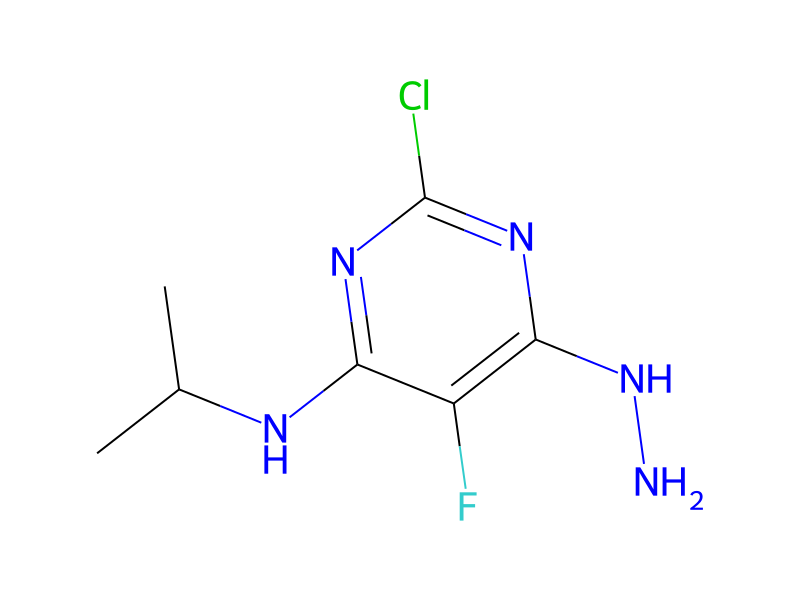
Methanol → 2-chloro-5-fluoro-6-hydrazino-N-(1-methylethyl)-4-pyrimidinamine
Reaction equation

CC(OC([N:8](C(OC(C)(C)C)=O)[N:9]([C:17]1[C:22]([F:23])=[C:21]([N:24]2[CH2:27][C:26](C)(N3CCCC3)C2)[N:20]=[C:19]([Cl:34])[N:18]=1)C(OC(C)(C)C)=O)=O)(C)C.[CH3:42]O>Cl.O1CCOCC1>[Cl:34][C:19]1[N:20]=[C:21]([NH:24][CH:27]([CH3:26])[CH3:42])[C:22]([F:23])=[C:17]([NH:9][NH2:8])[N:18]=1Participants
5
Reactant 2


Product 1
Reagents, catalysts & solvents 2


Procedure
A solution of tris(1,1-dimethylethyl)2-{2-chloro-5-fluoro-6-[3-methyl-3-(1-pyrrolidinyl)-1-azetidinyl]-4-pyrimidinyl}-1,1,2-hydrazinetricarboxylate (0.225 g, 0.37 mmol) in MeOH (6 mL) and 4.0M HCl in dioxane (4 mL) was stirred at room temperature for 3 days. The solvent was then removed in vacuo, providing the crude 2-chloro-5-fluoro-6-hydrazino-N-(1-methylethyl)-4-pyrimidinamine, presumably as the tri-HCl salt. LCMS: (M+H)+: 301.0.
Workup
- customThe solvent was then removed in vacuo
Sources & evidence
- ORD record
- ord-d1eba3613eb54c47a760b42069f5fe7f
- Source dataset
- uspto-grants-2011_02
- Patent number
- US07893056B2
Reaction notes
Loading…