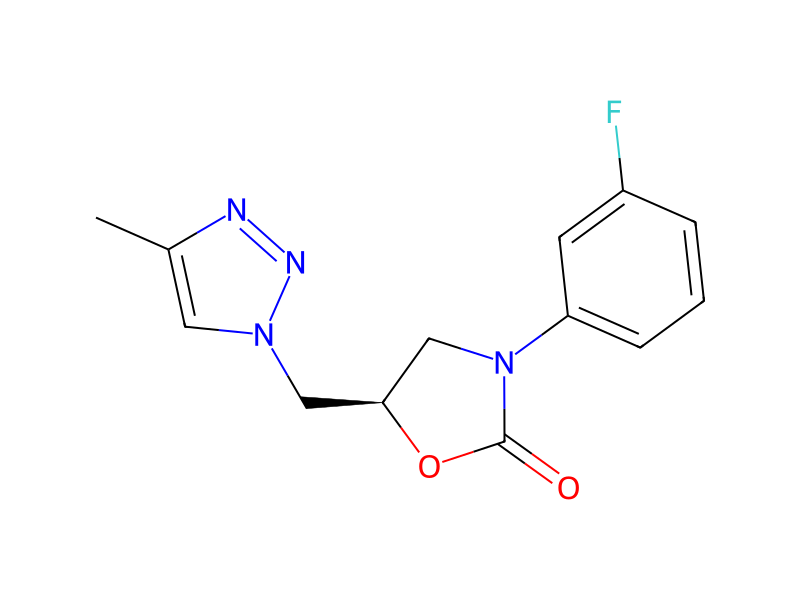
Diisopropylethylamine → (5R)-3-(3-Fluorophenyl)-5-[(4-methyl-1H-1,2,3-triazol-1-yl)methyl]-1,3-oxazolidin-2-one
Reaction equation

C(N(CC)C(C)C)(C)C.[NH2:10][CH2:11][C@@H:12]1[O:16][C:15](=[O:17])[N:14]([C:18]2[CH:23]=[CH:22][CH:21]=[C:20]([F:24])[CH:19]=2)[CH2:13]1.Cl[CH:26](Cl)[C:27](=[N:29][NH:30]S(C1C=CC(C)=CC=1)(=O)=O)[CH3:28]>CO>[F:24][C:20]1[CH:19]=[C:18]([N:14]2[CH2:13][C@H:12]([CH2:11][N:10]3[CH:26]=[C:27]([CH3:28])[N:29]=[N:30]3)[O:16][C:15]2=[O:17])[CH:23]=[CH:22][CH:21]=1Participants
5
Reactant 3



Product 1
Reagents, catalysts & solvents 1

Conditions
- Temperature
- 0 °C
Procedure
N,N-Diisopropylethylamine (3.20 ml, 18.35 mmol) was added to a solution of (5S)-5-(aminomethyl)-3-(3-fluorophenyl)-1,3-oxazolidin-2-one (0.77 g, 3.57 mmol) (see Patent Application: Dong Pharmaceuticals WO 01/94342) in anhydrous methanol (25 ml). The solution was cooled to 0° C., and N′-[2,2-dichloro-1-methylethylidene]-4-methylbenzenesulfonohydrazide (1.28 g, 4.58 mmol) was added. The solution was warmed to room temperature and stirred overnight. The reaction mixture was then concentrated under vacuum and chromatographed on silica gel using 2% methanol/dichloromethane to give 0.71 g of the title product.
Workup
- temperatureThe solution was warmed to room temperature
- concentrationThe reaction mixture was then concentrated under vacuum
- customchromatographed on silica gel using 2% methanol/dichloromethane
Sources & evidence
- ORD record
- ord-a66e0f5d024a4afbb2a2cbffc7dac4a5
- Source dataset
- uspto-grants-2007_01
- Patent number
- US07157482B2
Reaction notes
Loading…