Sodium borohydride → HCID 21071457, compound
Reaction equation
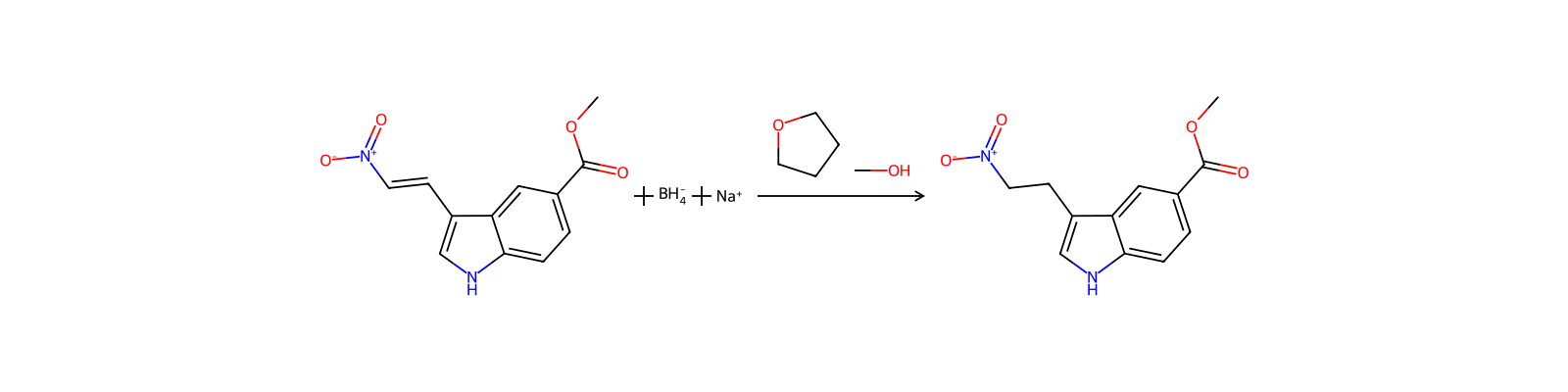
[N+:1]([CH:4]=[CH:5][C:6]1[C:14]2[C:9](=[CH:10][CH:11]=[C:12]([C:15]([O:17][CH3:18])=[O:16])[CH:13]=2)[NH:8][CH:7]=1)([O-:3])=[O:2].[BH4-].[Na+]>C1COCC1.CO>[N+:1]([CH2:4][CH2:5][C:6]1[C:14]2[C:9](=[CH:10][CH:11]=[C:12]([C:15]([O:17][CH3:18])=[O:16])[CH:13]=2)[NH:8][CH:7]=1)([O-:3])=[O:2]Participants
5
Reactant 2


Product 1

Reagents, catalysts & solvents 2


Procedure
Treat a solution of 3-(2-nitrovinyl)-5-methoxycarbonyl-1H-indole (57 mg, 0.23 mmol) in 9 mL THF and 2 mL MeOH with NaBH4 (26 mg, 0.69 mmol). Stir at ambient temperature overnight, concentrate to dryness and partition between conc. NH4OH (10 mL) and dichloromethane. Extract the aqueous layer with dichloromethane, acidify with conc. HCl and extract twice with dichloromethane. Combine the organic layers, concentrate, and chromatograph on silica gel eluting with 1% MeOH in CHCl3 to give the title compound as a solid: 1H NMR (CDCl3) 8.35 (bs, 1H), 8.32 (s, 1H), 7.92–7.90 (m, 1H), 7.38–7.36 (d, 1H), 7.12–7.11 (m, 1H), 4.69–4.65 (t, 2H), 3.93 (s, 3H), 3.51–3.48 (t, 2H); ISMS 248 (M+).
Workup
- concentrationconcentrate to dryness
- custompartition between conc. NH4OH (10 mL) and dichloromethane
- extractionExtract the aqueous layer with dichloromethane
- extractionextract twice with dichloromethane
- concentrationconcentrate
Sources & evidence
- ORD record
- ord-9228dcb3f133468baf962134de373fb1
- Source dataset
- uspto-grants-2007_01
- Patent number
- US07157488B2
Reaction notes
Loading…