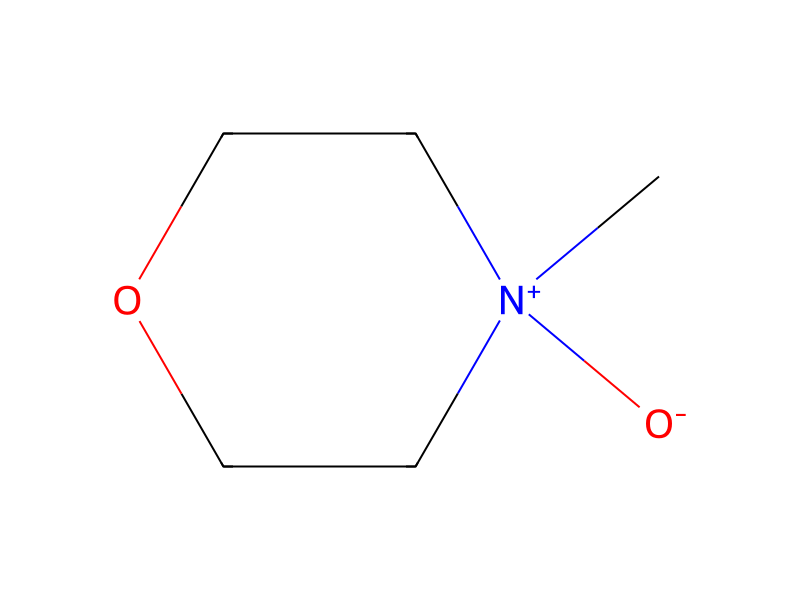
Methyl morpholine oxide → 1-N-Cbz-3-pyrrolidinone
Reaction equation

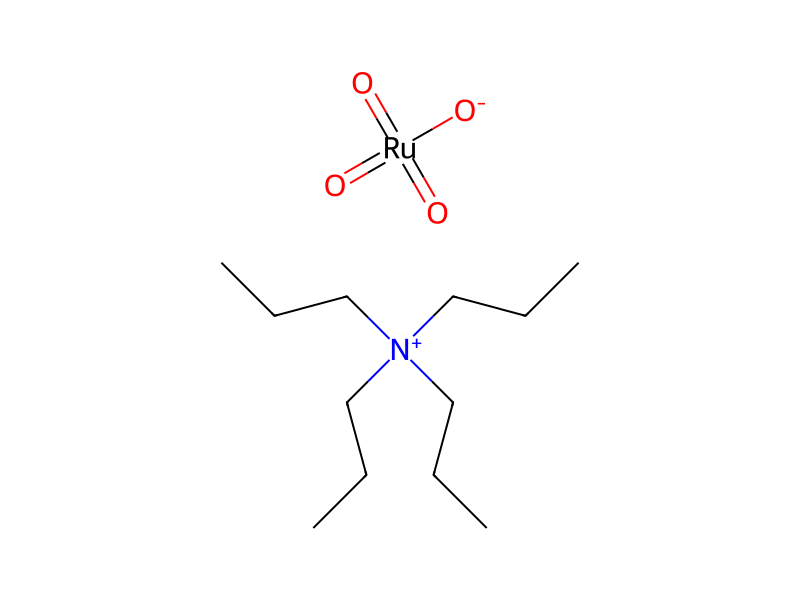
[OH:1][C@@H:2]1[CH2:6][CH2:5][N:4]([C:7]([O:9][CH2:10][C:11]2[CH:16]=[CH:15][CH:14]=[CH:13][CH:12]=2)=[O:8])[CH2:3]1.C[N+]1([O-])CCOCC1>[Ru]([O-])(=O)(=O)=O.C([N+](CCC)(CCC)CCC)CC.ClCCl>[O:1]=[C:2]1[CH2:6][CH2:5][N:4]([C:7]([O:9][CH2:10][C:11]2[CH:16]=[CH:15][CH:14]=[CH:13][CH:12]=2)=[O:8])[CH2:3]1Participants
Reactant 2

Product 1

Reagents, catalysts & solvents 2

Procedure
A 12-L, 3 neck round bottom flask equipped with a mechanical stirrer, thermocouple, condenser, and nitrogen bubbler was charged with 351 g (1.61 mol) of benzyl (3R)-3-hydroxypyrrolidine-1-carboxylate (Intermediate 1, Step A), 6 L of dichloromethane, 500 g of powdered molecular sieves, and 400 g (3.41 mol) of N-methylmorpholine-N-oxide. The resultant suspension was stirred at ambient temperature and to this was added 12.9 g (0.0367 mol) of tetrapropylammonium perruthenate. The reaction temperature was kept at ≦30° C. with a cold water bath. The mixture was stirred at ambient temperature for 2 h. The mixture was poured onto a plug of 5 kg of silica gel and eluted with 10% ethyl acetate/dichloromethane to give the title compound as an orange oil.
Workup
- customThe reaction temperature was kept at ≦30° C. with a cold water bath
- additionThe mixture was poured onto a plug of 5 kg of silica gel
- washeluted with 10% ethyl acetate/dichloromethane
Sources & evidence
- ORD record
- ord-596f4071547c49b19f5702973118fee2
- Source dataset
- uspto-grants-2007_01
- Patent number
- US07157490B2
Reaction notes
Loading…