2-Vinylpyridine → Piconol
Reaction equation

[CH:1]([C:3]1[CH:8]=[CH:7][CH:6]=[CH:5][N:4]=1)=[CH2:2].[O:9]=[O+][O-]>CO>[CH:1]([C:3]1[CH:8]=[CH:7][CH:6]=[CH:5][N:4]=1)=[CH2:2].[OH:9][CH2:1][C:3]1[CH:8]=[CH:7][CH:6]=[CH:5][N:4]=1Participants
Reactant 2
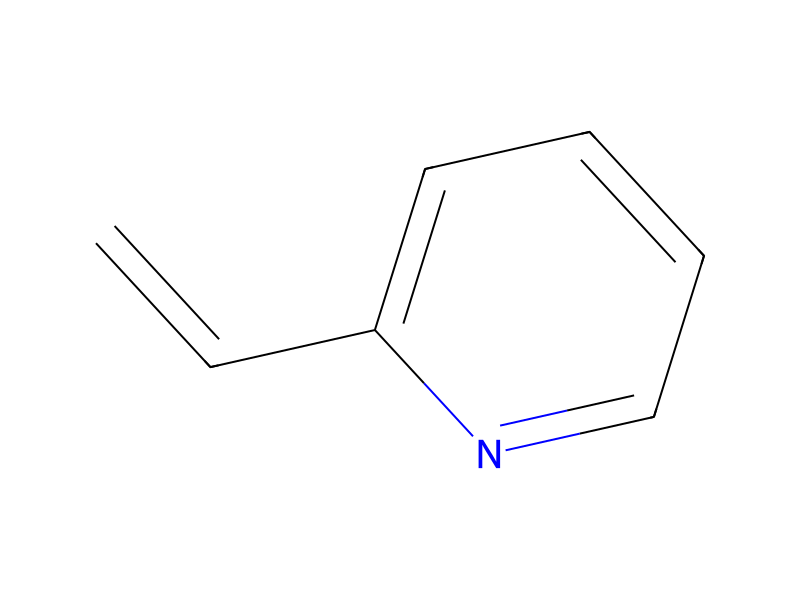

Product 2

Reagents, catalysts & solvents 1

Procedure
12 liters of a solution of 1250 [lacuna] of vinylpyridine (12 mol) in methanol were prepared, and a 1 molar solution of vinylpyridine in methanol was ozonized analogously to Example 3, a concentration of 20 g of vinylpyridine per liter being maintained in the ozonolysis by metered addition. A total of 12 l of solution and thus 12 mol of vinylpyridine were fed in. All of the ozone introduced was taken up. The resulting peroxide solution was stored in a deep-freeze at −30° C. and used for a further continuous ozonolysis at a vinylpyridine content of about 2 g/l. The total ozone consumption was, at 570 g or 98.9% of theory, somewhat lower than in Example 18. The resulting peroxide solution was hydrogenated analogously to Example 17. After work-up analogously to Example 18, 1024 [lacuna] (78.1% of theory) of hydroxymethylpyridine were obtained.
Workup
- customdeep-freeze at −30° C.
- customThe total ozone consumption
Sources & evidence
- ORD record
- ord-8d92f12f882d46cd98f7963719255a10
- Source dataset
- uspto-grants-2007_01
- Patent number
- US07169950B2
Reaction notes
Loading…