2,4-Difluoronitrobenzene → Glycine, N-(5-fluoro-2-nitrophenyl)-, ethyl ester
Reaction equation

F[C:2]1[CH:7]=[C:6]([F:8])[CH:5]=[CH:4][C:3]=1[N+:9]([O-:11])=[O:10].Cl.[CH2:13]([O:15][C:16](=[O:19])[CH2:17][NH2:18])[CH3:14].C(N(C(C)C)CC)(C)C>C(#N)C>[CH2:13]([O:15][C:16](=[O:19])[CH2:17][NH:18][C:2]1[CH:7]=[C:6]([F:8])[CH:5]=[CH:4][C:3]=1[N+:9]([O-:11])=[O:10])[CH3:14]Participants
5
Reactant 3
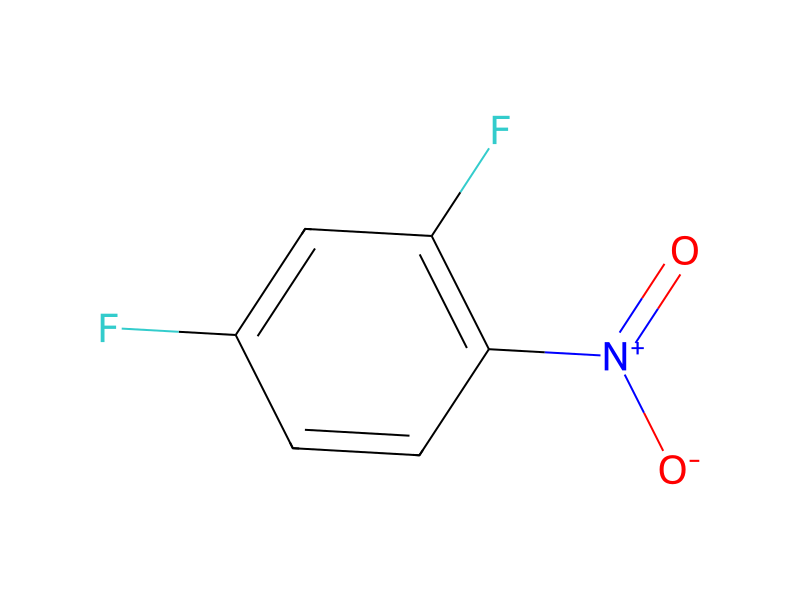


Product 1

Reagents, catalysts & solvents 1

Procedure
To a mixture of 2,4-difluoronitrobenzene (VII, 19.20 g), glycine ethyl ester hydrochloride (XII, 16.52 g), and acetonitrile (50 ml) is added diisopropylethylamine (42 ml). A mild exotherm ensues. The reaction is stirred (without cooling) for two hours. The acetonitrile is removed under reduced pressure and the residue is partitioned between dichloromethane and water. The organic layers are dried over sodium sulfate and concentrated to give the produce as a solid (single spot by TLC), mp 194°-195°; NMR (CDCl3) 1.33, 4.05, 4.30, 6.35, 6.45, 8.26 and 8.56 δ.
Workup
- temperature(without cooling) for two hours
- customThe acetonitrile is removed under reduced pressure
- customthe residue is partitioned between dichloromethane and water
- dry with materialThe organic layers are dried over sodium sulfate
- concentrationconcentrated
- customto give the
- customproduce as a solid (single spot by TLC), mp 194°-195°
Sources & evidence
- ORD record
- ord-d6d30e1621d34aa4ae6c798298cbb2c7
- Source dataset
- uspto-grants-1997_09
- Patent number
- US05668282
Reaction notes
Loading…