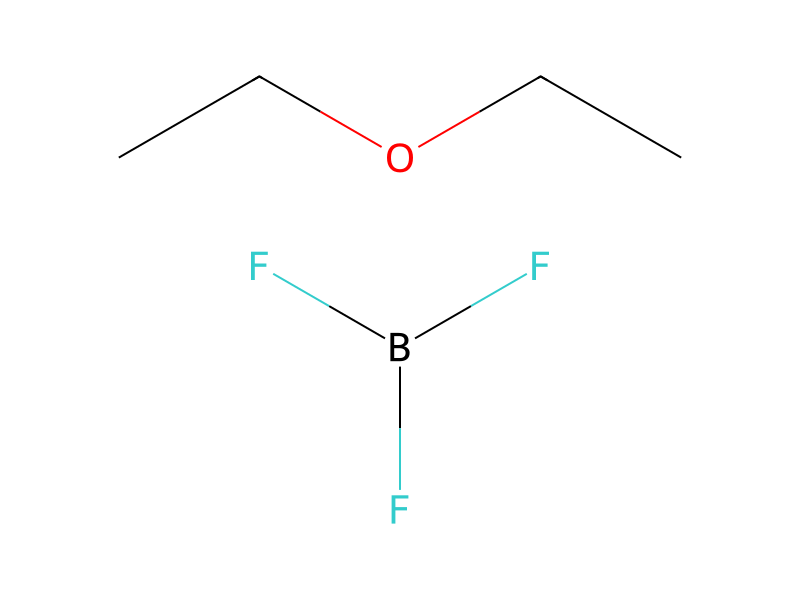
Boron trifluoride etherate → HCID 10899662, compound
Reaction equation

B(F)(F)F.CCOCC.[OH:10][CH:11]1[CH2:15][CH2:14][O:13][C:12]1=[O:16].[C:17]([N:21]=[C:22]=[O:23])([CH3:20])([CH3:19])[CH3:18].C(=O)(O)[O-].[Na+]>ClCCl.[Cl-].[Na+].O>[C:17]([NH:21][C:22]([O:10][CH:11]1[CH2:15][CH2:14][O:13][C:12]1=[O:16])=[O:23])([CH3:20])([CH3:19])[CH3:18]Participants
Reactant 4



Product 1

Reagents, catalysts & solvents 2


Procedure
Boron trifluoride diethyl etherate (1.38 g) was added dropwise, over a period of fifteen minutes, to a stirred solution of 3-hydroxytetrahydrofuran-2-one (10.0 g) and t-butylisocyanate (9.7 g) in dry dichloromethane (300 ml), whilst maintaining the temperature below 10° C. The mixture was stirred at room temperature for a further four hours, treated with brine and sufficient aqueous sodium bicarbonate solution to render the aqueous phase basic, then extracted several times with dichloromethane. The extracts were washed with brine, dried over magnesium sulphate and evaporated under reduced pressure to give the title compound (18.5 g, m.p. 104°-106° C.). NMR (CDCl3): δ 1.34(9H,s); 2.28(1H,m); 2.73(1H,m); 4.28(1H,dt); 4.46(1H,dt); 4.90(1H,bs); 5.31(1H,t). MS: M+ 201. The addition can also be catalysed using triethylamine or aqueous hydrogen chloride in place of boron trifluoride. However a rearrangement product can be formed in variable amounts which can necessitate purification of the desired material, for example by chromatography on silica using hexane-ethyl acetate (3:1) as eluant.
Workup
- temperaturewhilst maintaining the temperature below 10° C
- extractionextracted several times with dichloromethane
- washThe extracts were washed with brine
- dry with materialdried over magnesium sulphate
- customevaporated under reduced pressure
Sources & evidence
- ORD record
- ord-cdb6986590af4fcd9b50b9fb887eeb77
- Source dataset
- uspto-grants-1997_09
- Patent number
- US05670656
Reaction notes
Loading…