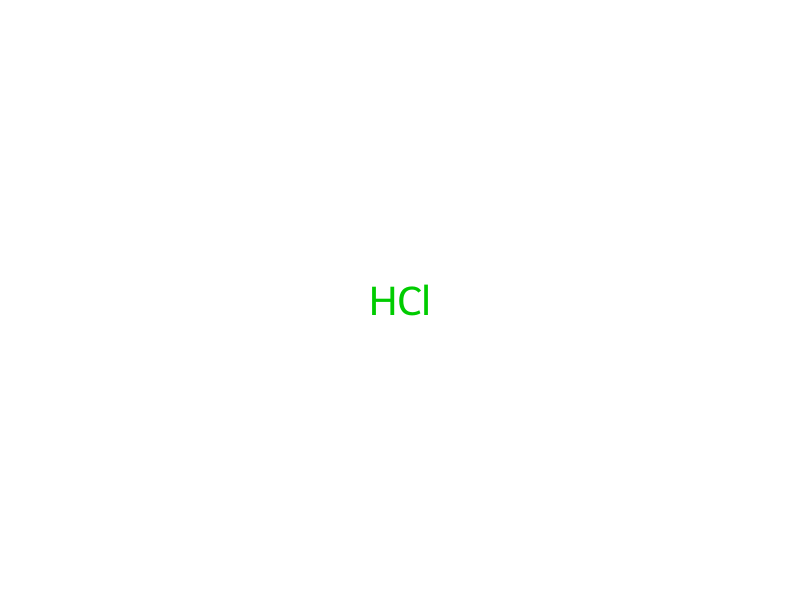
Hydrochloric Acid → Paroxetine HCl Ethanol
Reaction equation

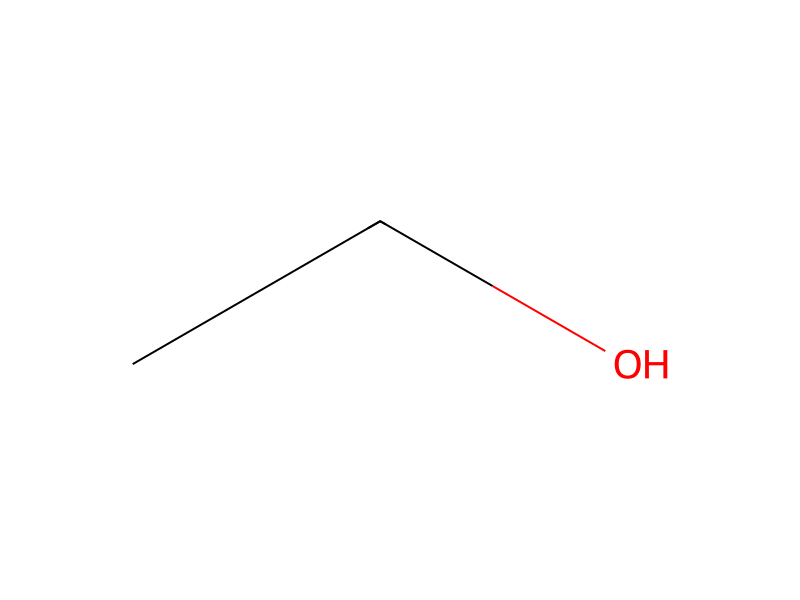
[CH:1]1[C:6]([C@H:7]2[C@H:12]([CH2:13][O:14][C:15]3[CH:16]=[CH:17][C:18]4[O:23][CH2:22][O:21][C:19]=4[CH:20]=3)[CH2:11][NH:10][CH2:9][CH2:8]2)=[CH:5][CH:4]=[C:3]([F:24])[CH:2]=1.[ClH:25]>C(O)C>[CH:5]1[C:6]([C@H:7]2[C@H:12]([CH2:13][O:14][C:15]3[CH:16]=[CH:17][C:18]4[O:23][CH2:22][O:21][C:19]=4[CH:20]=3)[CH2:11][NH:10][CH2:9][CH2:8]2)=[CH:1][CH:2]=[C:3]([F:24])[CH:4]=1.[ClH:25].[CH2:13]([OH:14])[CH3:12]Participants
Reactant 2

Product 1

Reagents, catalysts & solvents 1
Procedure
To a reaction flask containing 100 ml of absolute ethanol was added to 13.9 g of paroxetine base. The flask was shaken until a clear solution was obtained. To this paroxetine solution, 10 ml of a solution of hydrochloric acid in absolute ethanol (22% v/v) was added dropwise. As the reaction proceeded to completion, the color of the solution changed from a yellow brown to a pink brown. The product was then vacuum dried in a rotary evaporator. A foamy, amorphous solid was obtained (lot #W951027). The produced amorphous solid was subjected to an additional 2.5 days of drying in a dessicator at reduced pressure. The solid, a free-flowing powder, was tested for composition by NMR and FTIR. The findings were consistent with published spectra for paroxetine. Silver nitrate testing of the solid indicated the presence of chloride in the sample. Volatile analysis by gas chromatography revealed that the amount of ethanol present in the amorphous solid was 4% by weight. Residual moisture was determined by Karl-Fisher coulometric method at 0.7%. HPLC analysis revealed the material was >99% pure and essentially free from contamination. X-ray powder crystallography was conducted on the sample and produced the diffraction pattern shown in FIG. 1. X-ray powder diffraction was performed using the powder pack method. The powder patterns were obtained using a Philips PW1710 automated diffractometer, with monochromatized CuKα (Kα1 =1.54060 Å; Kα2 =1.54438 Å) radiation. The diffractometer was equipped with a compensating slit and a graphite monochromator. It was calibrated to 0.02° (2θ) using the quartz peak at 26.66° (2θ). The minimum peak/background ratio was 0.75. This spectrum is consistent with an amorphous solid form. The halo effect is clearly seen and the intensity is small. Differential scanning calorimetry was performed on the solid at two different heating rates. The results indicate an endotherm at 48° C. (heat flow) with and absence of other endotherms (FIG. 3A and FIG. 3B). Visual examination showed a "glassing" of the solid at this temperature.
Workup
- customwas obtained
- customvacuum dried in a rotary evaporator
- customA foamy, amorphous solid was obtained (lot #W951027)
- customof drying in a dessicator at reduced pressure
- customproduced the diffraction pattern
- customThe powder patterns were obtained
- customThe diffractometer was equipped with a compensating slit
- customwas calibrated to 0.02°
- customat 26.66°
- temperaturedifferent heating rates
- customat 48° C.
- temperature(heat flow) with and absence of other endotherms (FIG. 3A and FIG. 3B)
Sources & evidence
- ORD record
- ord-c0d447c10acb48069cc7e41dfde9be20
- Source dataset
- uspto-grants-1997_09
- Patent number
- US05672612
Reaction notes
Loading…