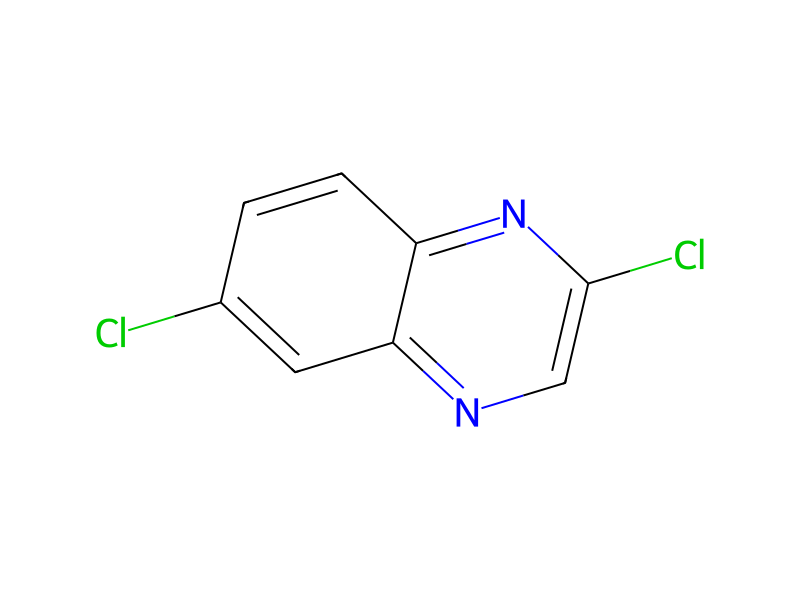
Phosphorus oxychloride → 2,6-Dichloroquinoxaline
Reaction equation

O[C:2]1[CH:11]=[N:10][C:9]2[C:4](=[CH:5][CH:6]=[C:7]([Cl:12])[CH:8]=2)[N:3]=1.P(Cl)(Cl)([Cl:15])=O>>[Cl:15][C:2]1[CH:11]=[N:10][C:9]2[C:4](=[CH:5][CH:6]=[C:7]([Cl:12])[CH:8]=2)[N:3]=1Participants
3


Procedure
45 g of 2-hydroxy-6-chloroquinoxaline are treated in a sulphonation flask with 100 ml of phosphorus oxychloride. The mixture is stirred at reflux temperature for 20 minutes. The excess phosphorus oxychloride is thereupon distilled off and the residue is treated with 500 ml of ice-water. The product obtained is filtered off and washed with water until it is neutral. By crystallization from ethanol/water there is obtained 2,6-dichloroquinoxaline of melting point 152° C.
Workup
- temperatureat reflux temperature for 20 minutes
- distillationThe excess phosphorus oxychloride is thereupon distilled off
- additionthe residue is treated with 500 ml of ice-water
- customThe product obtained
- filtrationis filtered off
- washwashed with water until it
- customBy crystallization from ethanol/water there
Sources & evidence
- ORD record
- ord-14819dabc4ab47d3a702cc75653d95fa
- Source dataset
- uspto-grants-1986_04
- Patent number
- US04582526
Reaction notes
Loading…