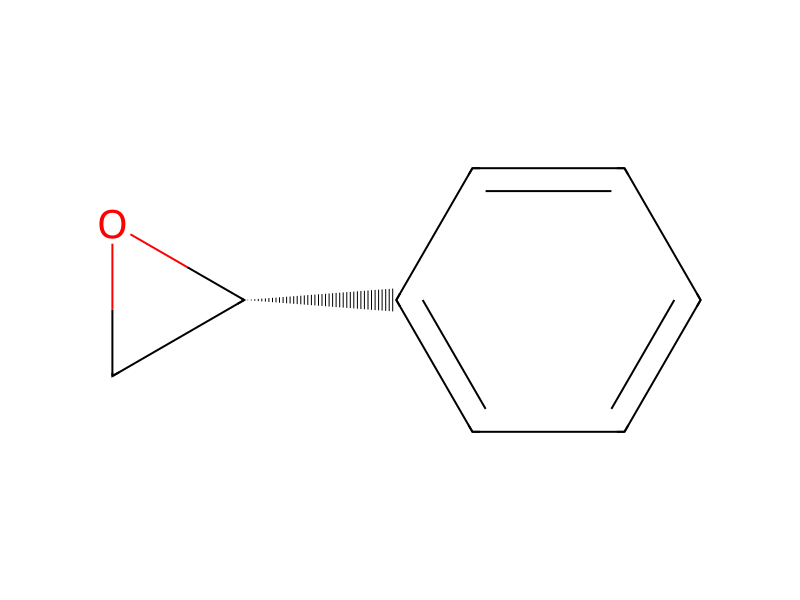
(+)-Styrene oxide → HCID 18607072, compound
Reaction equation

[NH2:1][CH2:2][CH2:3][CH2:4][C:5]1[CH:10]=[CH:9][C:8]([S:11]([NH2:14])(=[O:13])=[O:12])=[CH:7][CH:6]=1.[CH2:15]1[O:23][C@@H:16]1[C:17]1[CH:22]=[CH:21][CH:20]=[CH:19][CH:18]=1>C(#N)C>[OH:23][C@H:16]([C:17]1[CH:22]=[CH:21][CH:20]=[CH:19][CH:18]=1)[CH2:15][NH:1][CH2:2][CH2:3][CH2:4][C:5]1[CH:6]=[CH:7][C:8]([S:11]([NH2:14])(=[O:12])=[O:13])=[CH:9][CH:10]=1Participants
4
Reactant 2

Product 1

Reagents, catalysts & solvents 1

Procedure
A mixture of 20 g of 4-(3-aminopropyl)benzenesulphonamide, 16.8 g of (R)-styrene oxide and 500 ml of acetonitrile was heated under reflux for 40 hours. The solvent was then removed by evaporation in vacuo and the residue was chromatographed on 1 kg of silica gel. With chloroform/n-propanol25% ammonia (1600:100:4) there could be isolated 8.3 g of pure p-[3-[[(R)-β-hydroxyphenethyl]amino]propyl]benzenesulphonamide of melting point 165°-166° (from acetonitrile); [α]D20 =-13.4° (c=1.0% in methanol); ε224 =14710.
Workup
- temperaturewas heated
- temperatureunder reflux for 40 hours
- customThe solvent was then removed by evaporation in vacuo
- customthe residue was chromatographed on 1 kg of silica gel
Sources & evidence
- ORD record
- ord-e0b45795a5264de39e056b39da8c9384
- Source dataset
- uspto-grants-1986_04
- Patent number
- US04585796
Reaction notes
Loading…