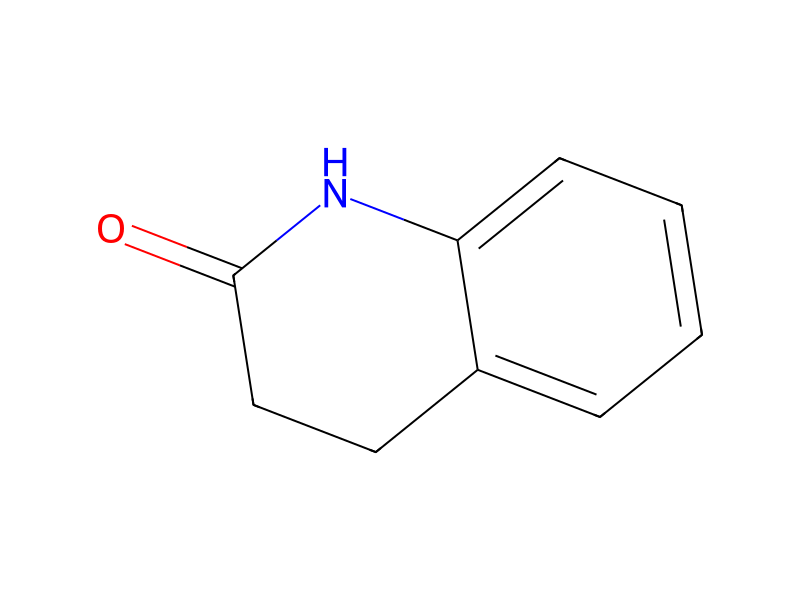
Hydrocarbostyril → 2(1H)-Quinolinone, 6-(2-chloro-1-oxopropyl)-3,4-dihydro-
Reaction equation

[Al+3].[Cl-].[Cl-].[Cl-].[Cl:5][CH:6]([CH3:10])[C:7](Cl)=[O:8].[NH:11]1[C:20]2[C:15](=[CH:16][CH:17]=[CH:18][CH:19]=2)[CH2:14][CH2:13][C:12]1=[O:21]>C(=S)=S>[Cl:5][CH:6]([CH3:10])[C:7]([C:17]1[CH:16]=[C:15]2[C:20](=[CH:19][CH:18]=1)[NH:11][C:12](=[O:21])[CH2:13][CH2:14]2)=[O:8]Participants
5




Procedure
A suspension of 72.5 g (0.544 mol) of AlCl3 in 800 mL of CS2 was stirred under dry N2 while 14.1 mL (20.0 g, 0.177 mol) of 2-chloropropionyl chloride was added followed by 20.0 g (0.136 mol) of 3,4-dihydroquinolin-2(1H)-one. The reaction mixture was refluxed for 4 h at which time a separation of phases was noted. The reaction was quenched by pouring onto ice with vigorous stirring. The pale yellow precipitate which formed was separated by filtration, washed with water and dried overnight over P2O5 to give 27.7 g (91%) of the desired product, m.p. 236.5-238° C.
Workup
- additionwas added
- temperatureThe reaction mixture was refluxed for 4 h at which time
- customa separation of phases
- customThe reaction was quenched
- additionby pouring onto ice with vigorous stirring
- customThe pale yellow precipitate which formed
- customwas separated by filtration
- washwashed with water
- dry with materialdried overnight over P2O5
Sources & evidence
- ORD record
- ord-3a5dd8ac4b8c4f9b9e762ad175161e5c
- Source dataset
- uspto-grants-2001_07
- Patent number
- US06255322B1
Reaction notes
Loading…