Dimethylformamide dimethyl acetal → Ethyl 3-(dimethylamino)-2-isocyanoacrylate
Reaction equation

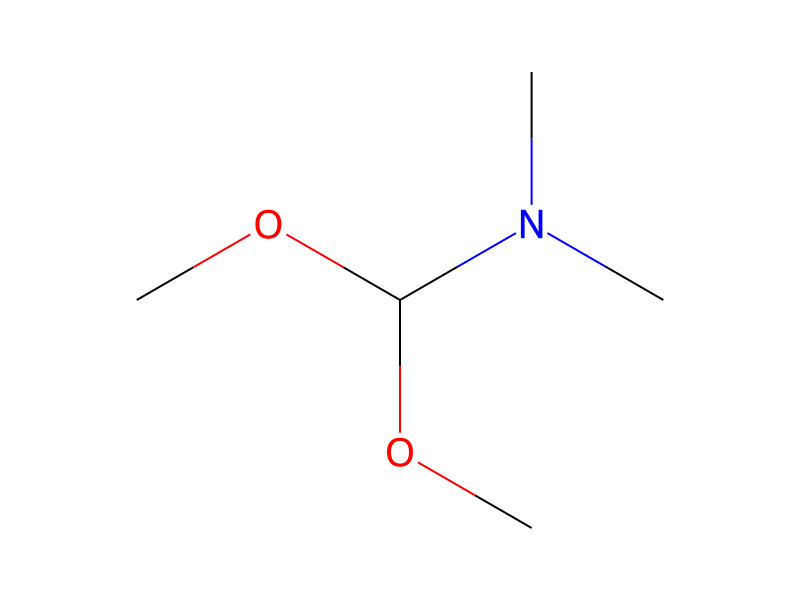
[N+:1]([CH2:3][C:4]([O:6][CH2:7][CH3:8])=[O:5])#[C-:2].CO[CH:11](OC)[N:12]([CH3:14])[CH3:13]>C(O)C>[CH2:7]([O:6][C:4](=[O:5])[C:3]([N+:1]#[C-:2])=[CH:11][N:12]([CH3:14])[CH3:13])[CH3:8]Participants
4
Reactant 2

Product 1

Reagents, catalysts & solvents 1

Procedure
4-carboalkoxythiazoles are prepared essentially according to the procedure of Schollkopf, U., Porsch, P., Lau, H. Liebigs Ann. Chem. 1444 (1979). Thus, according to Method 55 and 56, reaction of ethyl isocyanoacetate with N,N-dimethylformamide dimethyl acetal in a suitable alcoholic solvent such as ethanol at room temperature gives the corresponding 3-dimethylamino-2-isocyano-acrylic acid ethyl ester. A solution of this compound in a suitable solvent such as tetrahydrofuran is treated with gaseous hydrogen sulfide in the presence of a suitable tertiary amine base such as triethylamine or diiso-propylethylamine or the like at room temperature to give the corresponding 4-carboethoxy-thiazole.
Sources & evidence
- ORD record
- ord-15cc29402b3f4edda41305149fc5c32d
- Source dataset
- uspto-grants-2001_07
- Patent number
- US06255349B1
Reaction notes
Loading…