Acetophenone → 2-phenylglycerol
Reaction equation

C[C:2]1[C@@H:19]([O:20][C:21]([C@H:23]([OH:40])[C@@H](NC(C2C=CC=CC=2)=O)C2C=CC=CC=2)=O)[CH2:18][C@:14]2(O)[C:15](C)(C)[C:3]=1[C@@H](OC(C)=O)C([C@@]1(C)[C@H]([C@@H]2OC(C2C=CC=CC=2)=O)[C@]2(OC(C)=O)CO[C@@H]2C[C@@H]1O)=O.[C:63](C1C=CC=CC=1)(=[O:65])C>>[C:19]1([O:20][CH:21]([CH2:23][OH:40])[CH2:63][OH:65])[CH:2]=[CH:3][CH:15]=[CH:14][CH:18]=1Participants
Reactant 2

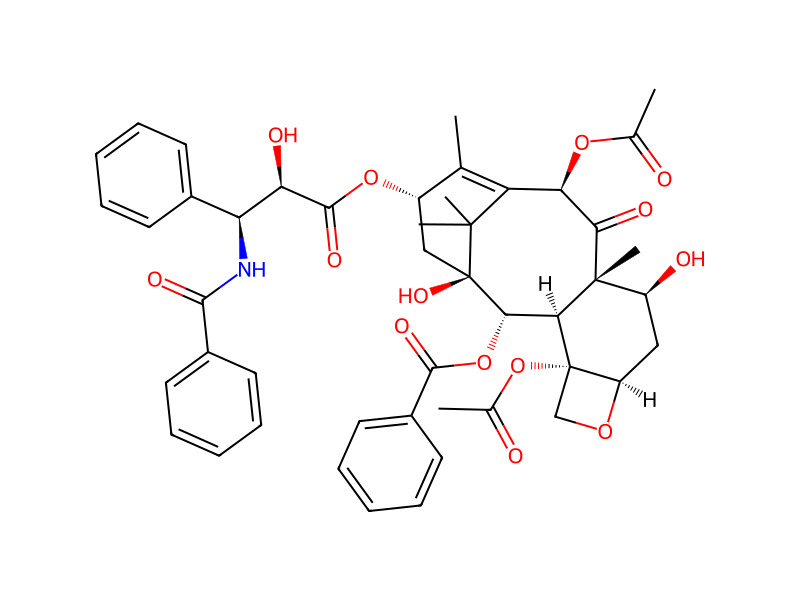
Product 1

Procedure
Anticipating a ring closure similar to that developed by Holton et al., 1994 during their total synthesis of paclitaxel, (Holton, R. A.; Somoza, C.; Kim, H. B.; Liang, F.; Biedeger, R. J.; Boatman, P. D.; Shindo, M.; Smith, C. C.; Kim, S.; Nadizadeh, H.; Suzuki, Y.; Tao, C.; Vu, P.; Tang, S.; Zhang, P.; Murthi, K. K.; Gentile, L. N.; Liu, J. H. J. Am. Chem. Soc. 1994, 116, 1597 and Holton, R. A.; Kim, H. B.; Somoza, C.; Liang, F.; Biedeger, R. J.; Boatman, P. D.; Shindo, M.; Smith, C. C.; Kim, S.; Nadizadeh, H.; Suzuki, Y.; Tao, C.; Vu, P.; Tang, S.; Zhang, P.; Murthi, K. K.; Gentile, L. N.; Liu, J. H. J. Am. Chem. Soc. 1994, 116, 1599) the inventors initially deployed acetophenone, 2, according to FIG. 1 as the most inexpensive and directly analogous starting material appropriate for producing 2-phenylglycerol, 1 where R=Ø, which could then be used as the key building block for further elaboration into the desired oxetanes. Toward this end, the enol form of acetophenone, 2, was trapped as its trimethylsilyl (TMS) ether (Step a) (Rubottom, G. M.; Gruber, J. M.; Juve, Jr., H. D.; Charleson, D. A. Org. Synth. 1986, 64, 118) which was vacuum distilled (42-43° C., 0.10 mm Hg) prior to its oxidation with meta-chloroperbenzoic acid (Step b) to produce α-hydroxyacetophenone. In addition to having appropriate NMR spectroscopic data, crystallization of the latter from hexane/ethyl acetate (1/1) provided material having a melting point of 88-90° C. which is comparable to the technical literature (Yorozu, K.; Takai, T.; Yamada, T.; Mukaiyama, T. Bull Chem. Soc. Jpn. 1994, 67, 2195: melting point=87 to 89° C.) as well as to commercial grade specifications (Aldrich Chem. Co.: melting point=86 to 89° C. and Acros Organics/Fisher Scientific: melting point=86 to 88° C.). Formation of the TMS ether (Step c) followed by immediate reaction with methylmagnesium bromide (Step d) then produced racemic 1,2-dihydroxy-2-phenylpropane. Flash chromatography and crystallization of the latter from hexane/ether (1/1) provided material again having appropriate NMR data and a melting point of 43-45° C. which is comparable to both the technical literature and commercial grade specifications (Eliel, E. L.; Freeman, J. P. J. Am. Chem. Soc. 1952, 74, 923: melting point=44 to 45° C. and Aldrich Chem. Co.: mp=44 to 45° C., respectively). However, at this point the overall yield for just the first four steps of this eight-step strategy had already plummeted to less than 20%. Thus, a higher yielding and more expedient pathway to compound 1 was sought and the latter steps of this first approach, as shown by dotted lines in FIG. 1, were not pursued.
Sources & evidence
- ORD record
- ord-626f82f8758a47209eb2f5eb6d46038d
- Source dataset
- uspto-grants-2001_07
- Patent number
- US06255540B1
Reaction notes
Loading…