Phenol → 4-Ethynylphenol
Reaction equation

[CH:1]([C:3]1[CH:8]=[CH:7][C:6]([OH:9])=[CH:5][CH:4]=1)=[CH2:2].C(C1C=CC(O)=CC=1)C.C1(O)C=CC=CC=1.C1C(O)=CC=C(C)C=1.N(C(C)(C)C(OC)=O)=NC(C)(C)C(OC)=O>CO.O>[CH:2]#[C:1][C:3]1[CH:8]=[CH:7][C:6]([OH:9])=[CH:5][CH:4]=1Participants
8


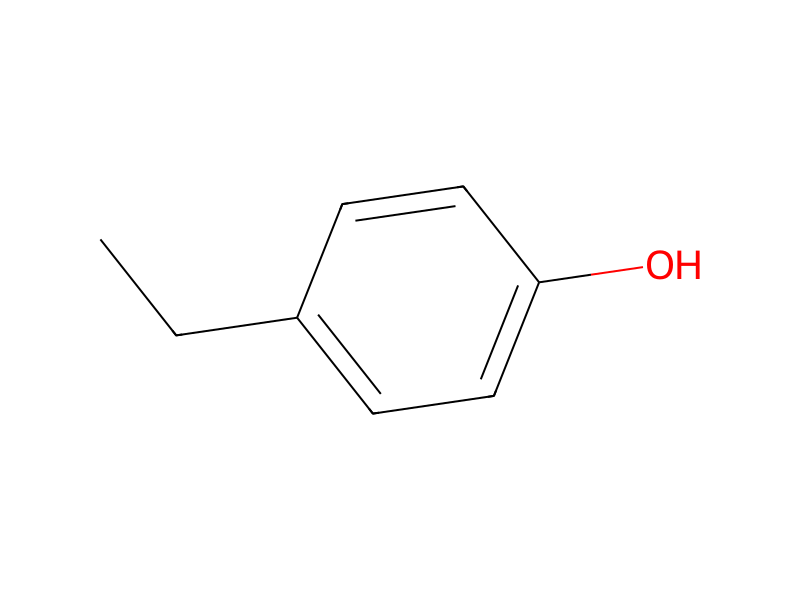
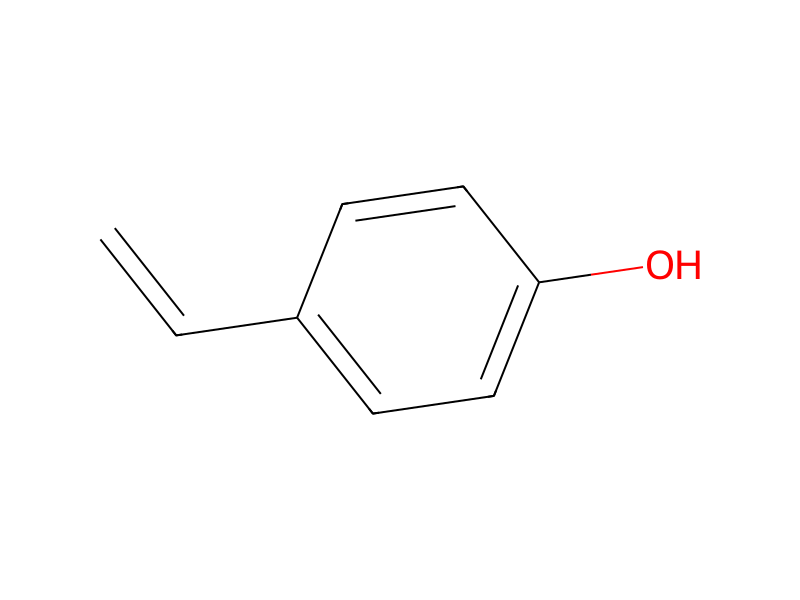




Procedure
To 536.3 g of a p-vinylphenol fraction obtained by the same vacuum flash distillation as in Example 1, containing 32.9% of p-vinylphenol, 49.1% of p-ethylphenol, 1.6% of phenol, 7.0% of p-cresol and 9.4% of water were added 160.9 g of methanol as a solvent and 5.36 g of dimethyl 2,2′-azobisisobutyrate as an initiator. The resulting mixture was subjected to a polymerization reaction at 80° C. for 5 hours. The reaction mixture was treated in the same manner as in Example 1 to obtain 98.2 g of a poly(p-vinylphenol). The polymer had a Mw of 8,800, a Mn of 5,200 and a light transmittance at 248 nm, of 76.9%.
Workup
- customThe resulting mixture was subjected to a polymerization reaction at 80° C. for 5 hours
- additionThe reaction mixture was treated in the same manner as in Example 1
Sources & evidence
- ORD record
- ord-eababc8de52b45c6a8092f834edb8550
- Source dataset
- uspto-grants-2001_07
- Patent number
- US06258901B1
Reaction notes
Loading…