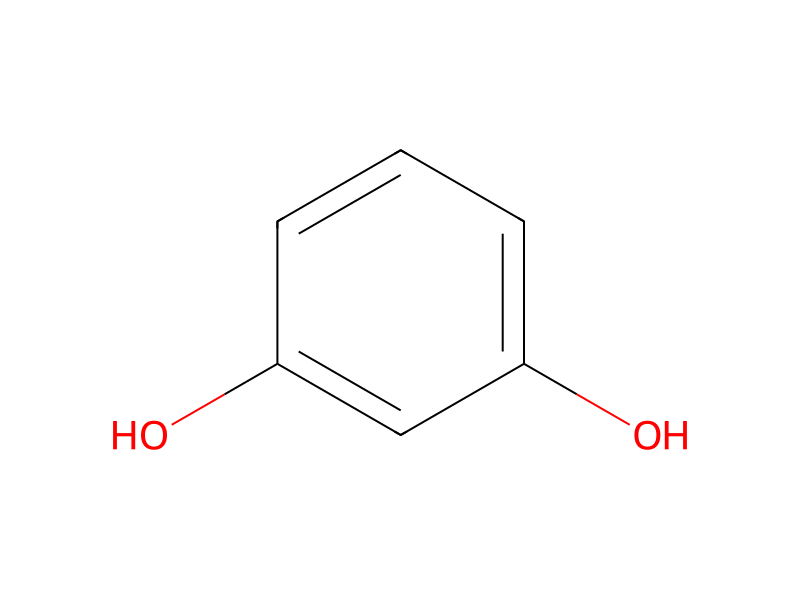
Resorcinol → HCID 15880045, compound
Reaction equation

[OH:1][C:2]1[CH:7]=[CH:6][CH:5]=[C:4]([OH:8])[CH:3]=1.[OH-].[K+].O.Br[C:13]([F:19])([F:18])[C:14]([F:17])([F:16])[Br:15]>CS(C)=O>[Br:15][C:14]([F:17])([F:16])[C:13]([F:19])([F:18])[O:1][C:2]1[CH:7]=[CH:6][CH:5]=[C:4]([O:8][C:13]([F:19])([F:18])[C:14]([F:17])([F:16])[Br:15])[CH:3]=1Participants
Reactant 3


Product 1

Reagents, catalysts & solvents 1

Conditions
- Temperature
- 100 °C
Procedure
Into a 250 mL round-bottom flask were placed 18.72g (0.17 mol) of 1,3-dihydroxybenzene (resorcinol) and 75 mL of DMSO. The solution was purged with nitrogen gas for one hour followed by adding 223.62 mL of 1.52M (0.34 mol) KOH-water solution dropwise to the solution, with the reaction flask resting in an ice-bath. The reaction mixture was then heated at 100° C. for one day followed by distilling off most of the water from the reaction solution. The rest of reaction solvents were evaporated slowly under vacuum. The salt was dried at 120° C. under the vacuum line for at least two days. Then 75 mL of dry DMSO and 109.2 g (0.42 mol) of 1,2-dibromo tetrafluoroethane was transferred to the flask via a closed system. The mixture was stirred at 35° C. for 3 days. The reaction mixture was filtered to remove the KBr, then the reaction mixture was washed with acetone in a 500 mL separatory funnel and the organic layer was diluted with 150 mL of methylene chloride. The combined organic layer was washed first with 10% of sodium bicarbonate water solution, and then with 0.01N HCl and finally with distilled water until neutral. The solution was dried over sodium sulfate overnight. After the removal of the sodium sulfate by filtration and the evaporation of the solvents, the crude product was purified by distillation under reduced pressure with an oil bath at a temperature of 100-110° C. A total of 64 g (0.136 mol) of 1,3-di(2-bromotetrafluoro ethoxy)benzene was obtained in 80.4% yield, which had a boiling point of 76-80° C. (at 10−2 torr). The amount of hydrogen by-product in the product was about 5.4%.
Workup
- customInto a 250 mL round-bottom flask were placed
- customThe solution was purged with nitrogen gas for one hour
- customwith the reaction flask resting in an ice-bath
- distillationby distilling off most of the water from the reaction solution
- customThe rest of reaction solvents
- customwere evaporated slowly under vacuum
- customThe salt was dried at 120° C. under the vacuum line for at least two days
- filtrationThe reaction mixture was filtered
- customto remove the KBr
- washthe reaction mixture was washed with acetone in a 500 mL separatory funnel
- additionthe organic layer was diluted with 150 mL of methylene chloride
- washThe combined organic layer was washed first with 10% of sodium bicarbonate water solution
- dry with materialThe solution was dried over sodium sulfate overnight
- customAfter the removal of the sodium sulfate
- filtrationby filtration
- customthe evaporation of the solvents
- distillationthe crude product was purified by distillation under reduced pressure with an oil bath at a temperature of 100-110° C
Sources & evidence
- ORD record
- ord-2f649e9ecd744a9499185cd86fea2977
- Source dataset
- uspto-grants-2001_07
- Patent number
- US06268532B1
Reaction notes
Loading…