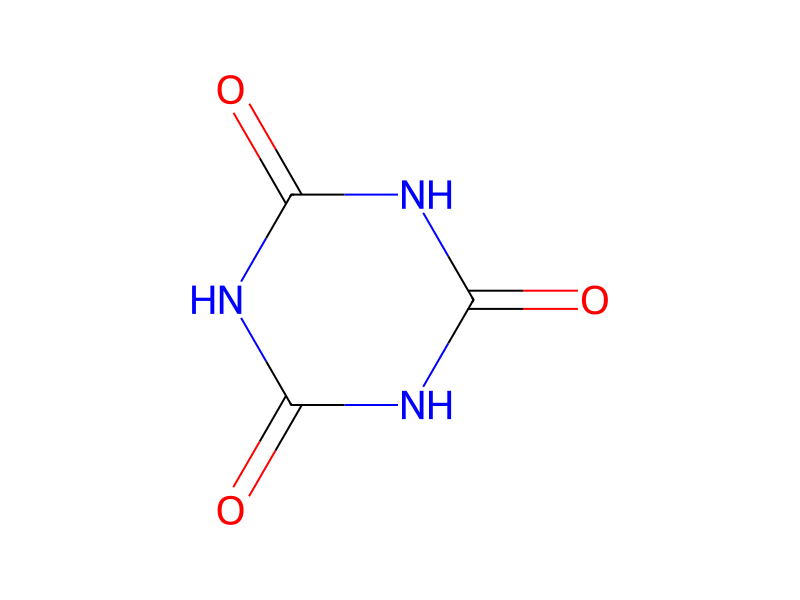
Carbon Dioxide → Cyanuric acid
Reaction equation

[C:1](=[O:4])([O-:3])[O-:2].[Na+:5].[Na+].[C:7](=[O:10])([O-:9])[OH:8].[Na+].O.[NH:13]1[C:20](=[O:21])[NH:19][C:17](=[O:18])[NH:16][C:14]1=[O:15].C(=O)=O>O>[NH:13]1[C:20](=[O:21])[NH:19][C:17](=[O:18])[NH:16][C:14]1=[O:15].[C:1](=[O:2])([O-:4])[O-:3].[Na+:5].[Na+:5].[C:7](=[O:8])([O-:10])[OH:9].[Na+:5]Participants





Procedure
In the process according to the invention, iso cyanuric acid is charged as a hydrate into a reaction vessel, or iso cyanuric acid is reacted with water present in a reaction system to produce the hydrate. Thus, the material can be mixed with sodium carbonate or sodium hydrogencarbonate very uniformly. The reaction system is then heated to a temperature above approximately 58° C., at which a transition of the iso cyanuric acid hydrate takes place. As a result, free water is produced. Alkali is dissolved in the liberated water. The neutralizing reaction thus brought about further produces water. The water produced as a result of the neutralization causes a further reaction. Since the reaction takes place in a fashion of chain reactions, water in the reaction system is gasificated by CO2 gas produced in the reaction of iso cyanuric acid with sodium carbonate or sodium hydrogencarbonate. Thus, the reaction system in the reaction vessel can be mixed while substantially maintaining the system as dry powder. The intended product thus can be obtained under quantitative control. In addition, any drying step usually can be dispensed with.
Workup
- customThe neutralizing reaction
- customa result of the neutralization
- customa further reaction
Sources & evidence
- ORD record
- ord-94c041682acc452b830e0794072f5679
- Source dataset
- uspto-grants-1984_02
- Patent number
- US04432959
Reaction notes
Loading…