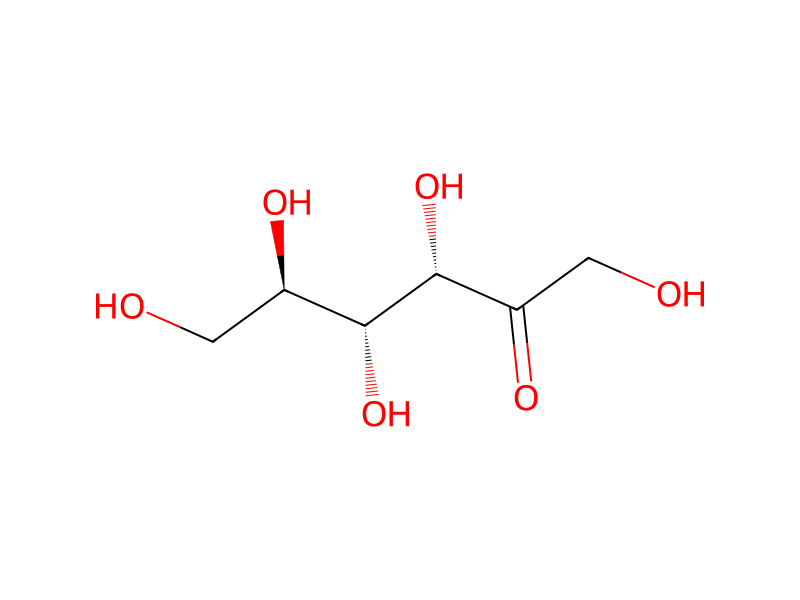
(2R,3S,4R,5R)-2,3,4,5,6-pentahydroxyhexanal → D-(-)-Fructose
Reaction equation

[O:1]=[CH:2][C@@H:3]([C@H:5]([C@@H:7]([C@@H:9]([CH2:11][OH:12])[OH:10])[OH:8])[OH:6])[OH:4]>O>[OH:1][CH2:2][C:3]([C@H:5]([C@@H:7]([C@@H:9]([CH2:11][OH:12])[OH:10])[OH:8])[OH:6])=[O:4]Participants
3

Reagents, catalysts & solvents 1

Procedure
A water white, clear dextrose liquor 40 having a D.E. of over 95 is recovered from the ion exchange treatment. This dextrose liquor 40 is concentrated to about 45% dissolved solids in an evaporator 41. Its pH is then adjusted to within the range of about 8 to about 8.5 with active magnesium oxide in a mixing tank 42. Ideally, the ratio of dissolved magnesium to calcium is adjusted to at least 20:1 in the tank 42. The resulting liquor 43 is then ready for treatment with a glucose isomerase (such as that marketed by Novo Enzyme Corporation under the trade name "Sweetzyme") to produce a high fructose sweetener.
Workup
- customof over 95 is recovered from the ion exchange treatment
- concentrationThis dextrose liquor 40 is concentrated to about 45%
- dissolutiondissolved solids
- customin an evaporator 41
Sources & evidence
- ORD record
- ord-4c96452b3b2d4614b760a993ca258924
- Source dataset
- uspto-grants-1981_01
- Patent number
- US04247636
Reaction notes
Loading…