Styrene → Benzene, ethenyl-, polymer with 1,3-butadiene
Reaction equation

[CH2:1]=[CH:2][CH:3]=[CH2:4].[CH2:5]=[CH:6][C:7]1[CH:12]=[CH:11][CH:10]=[CH:9][CH:8]=1.C([Li])CCC.O1CCCC1>CCCCCCC>[CH2:1]=[CH:2][CH:3]=[CH2:4].[CH2:5]=[CH:6][C:7]1[CH:12]=[CH:11][CH:10]=[CH:9][CH:8]=1Participants
Reactant 4




Product 1
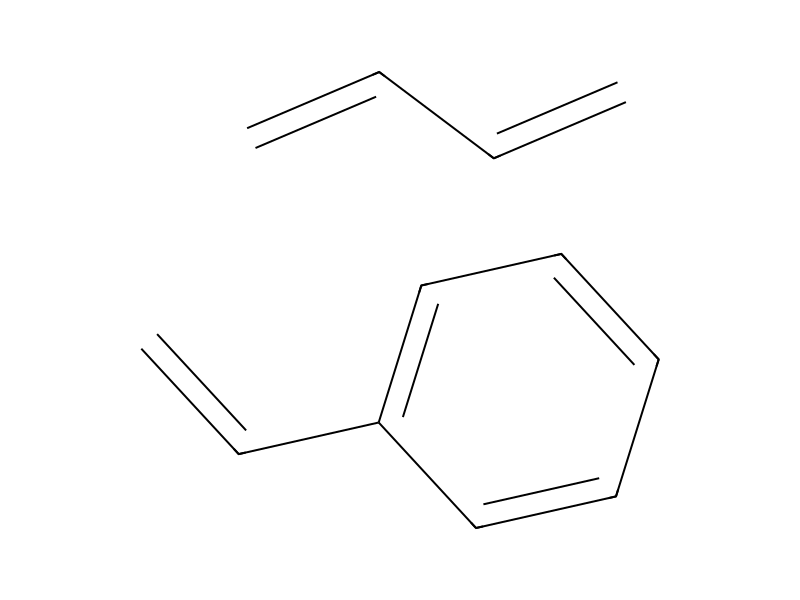
Reagents, catalysts & solvents 1

Procedure
Into three identical reactors of 14 liters useful capacity arranged in cascade with agitators of the turbine type rotating at 700 to 1100 rpm. butadiene and styrene were continuously introduced in a weight ratio of 69% and 31%, respectively, with a solution of active n-butyllithium in heptane corresponding to 0.05 part by weight of initiator to 100 parts by weight of monomers (i.e., 0.05 pcm.) and a solution of tetrahydrofuran (THF) in heptane such that there were between 450 and 550 ppm. of tetrahydrofuran in the reaction medium. The rates of flow of these different solutions were calculated so as to have an average retention time in all three reactors of between 1 to 2 hours and so as to obtain at the outlet of the third reactor a solution of butadiene-styrene copolymer in heptane (90%) and residual unreacted monomers corresponding to a conversion rate of 90%. Depending on the experimental conditions selected the temperatures being maintained constant and between 20° C. and 110° C., there has been found the formation of gel which rapidly makes control of the reaction very difficult and leads to a stopping of the operation of the reactors at the end of at least 2 days and at most 6 days.
Workup
- customof between 1 to 2 hours
Sources & evidence
- ORD record
- ord-653895200c814fc1898f106fc4fc1fe3
- Source dataset
- uspto-grants-1980_05
- Patent number
- US04202954
Reaction notes
Loading…