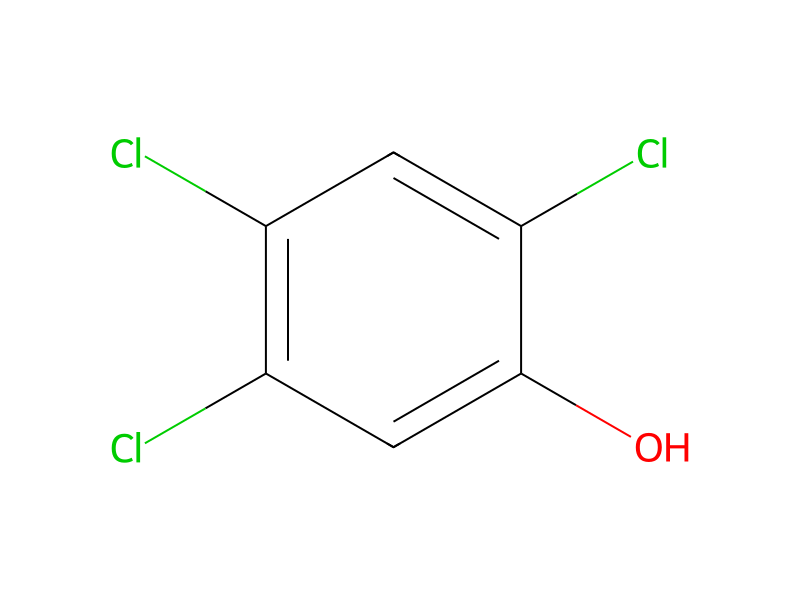
2,4,5-Trichlorophenol → HCID 20339745, compound
Reaction equation

[Cl:1][C:2]1[CH:7]=[C:6]([Cl:8])[C:5]([Cl:9])=[CH:4][C:3]=1[OH:10].[O:11]1[CH:16]=[CH:15][CH2:14][CH2:13][CH2:12]1>C1C=CC=CC=1.C1(S(O)(=O)=O)C2C(=CC=CC=2)C=CC=1>[Cl:1][C:2]1[CH:7]=[C:6]([Cl:8])[C:5]([Cl:9])=[CH:4][C:3]=1[O:10][CH:12]1[CH2:13][CH2:14][CH2:15][CH2:16][O:11]1Participants
5
Reactant 2

Product 1

Reagents, catalysts & solvents 2


Procedure
2,4,5-trichlorophenol (9.85 g., 0.05 moles) and dihydropyran (9.1 ml., 0.10 moles) are mixed in 100 ml. of benzene as a solvent. Upon addition of 1.0 g. of naphthalene sulfonic acid, as catalyst, the reaction is exothermic and the solution turns a light purple color. The reaction mixture is cooled to room temperature and allowed to stand for about one-half hour. The reaction mixture is washed with dilute sodium carbonate solution and the color turns to a light orange. The solution is dried over magnesium sulfate and then the solvent is evaporated in vacuo to yield 14.5 g. of an orange oil, nD30 =1.5408.
Workup
- additionUpon addition of 1.0 g
- waitto stand for about one-half hour
- washThe reaction mixture is washed with dilute sodium carbonate solution
- dry with materialThe solution is dried over magnesium sulfate
- customthe solvent is evaporated in vacuo
- customto yield 14.5 g
Sources & evidence
- ORD record
- ord-e19d4b69218d4848a7255d68b064d5f9
- Source dataset
- uspto-grants-1980_05
- Patent number
- US04203998
Reaction notes
Loading…