Carbon tetrabromide → 1-(2,2-Dibromovinyl)-4-fluorobenzene
Reaction equation

[F:1][C:2]1[CH:9]=[CH:8][C:5]([CH:6]=O)=[CH:4][CH:3]=1.[C:10](Br)(Br)([Br:12])[Br:11].C1(P(C2C=CC=CC=2)C2C=CC=CC=2)C=CC=CC=1>C(Cl)Cl>[Br:11][C:10]([Br:12])=[CH:6][C:5]1[CH:8]=[CH:9][C:2]([F:1])=[CH:3][CH:4]=1Participants
5
Reactant 3


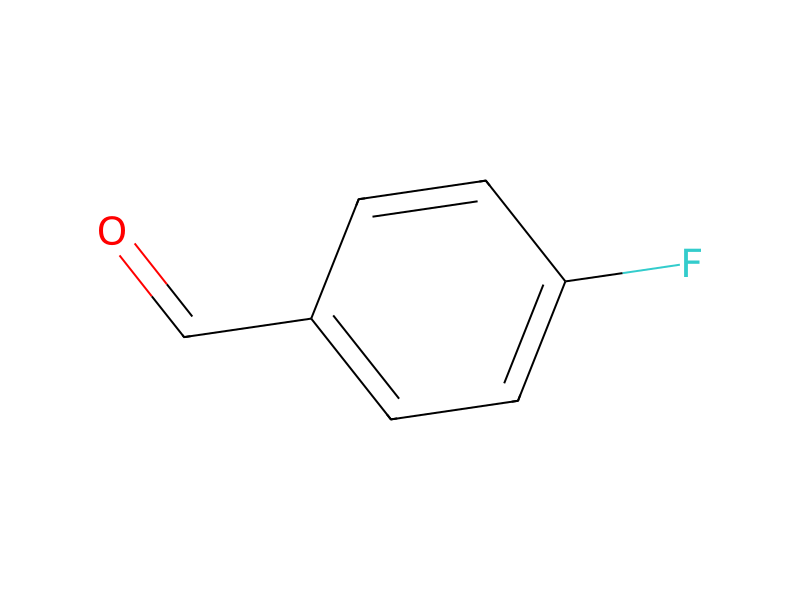
Product 1

Reagents, catalysts & solvents 1

Procedure
4-Fluoro benzaldehyde (1.23 g, 0.00995 mol) was dissolved in DCM (120 mL). Carbon tetrabromide (6.6 g, 0.0199 mol) and triphenylphosphine (10.42 g, 0.0398 mol) were added. The mixture was stirred at RT for 3 h. Insoluble material was removed by filtration, and the filtrate was concentrated under reduced pressure. The residue was purified through column chromatography (100% pentane in silica 100-200 mesh, Diameter of column—5.0 cm, height of silica—approx. 5 inch) to provide the desired compound as a yellow colored oil (1.1 g, 44% yield).
Workup
- customInsoluble material was removed by filtration
- concentrationthe filtrate was concentrated under reduced pressure
- customThe residue was purified through column chromatography (100% pentane in silica 100-200 mesh, Diameter of column—5.0 cm, height of silica—approx. 5 inch)
Sources & evidence
- ORD record
- ord-4e54b1e000a04c5ead291e1a159dbfaf
- Source dataset
- uspto-grants-2014_12
- Patent number
- US08907097B2
Reaction notes
Loading…