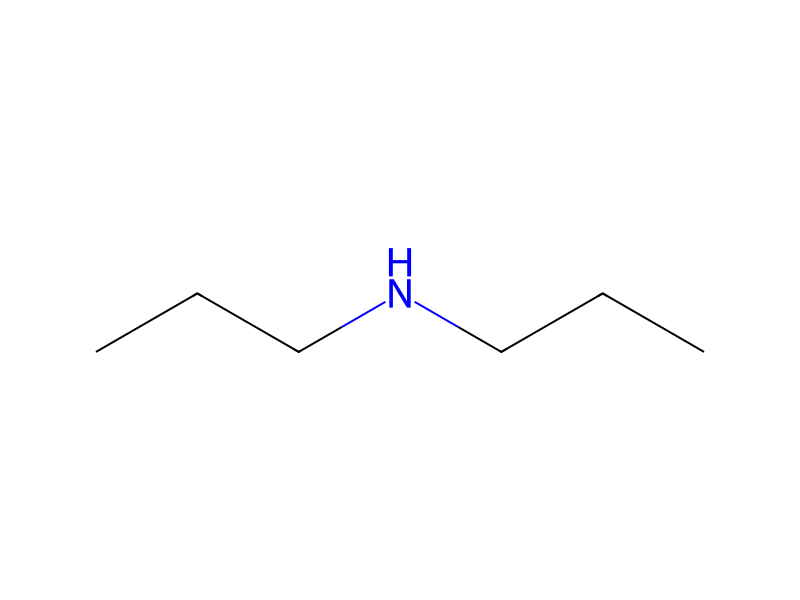
Dipropylamine → HCID 70664992, compound
Reaction equation

Cl[C:2]1[C:3]([C:16]2[CH:21]=[CH:20][C:19]([F:22])=[CH:18][CH:17]=2)=[N:4][C:5]2[C:10]([N:11]=1)=[CH:9][C:8]([C:12]([O:14][CH3:15])=[O:13])=[CH:7][CH:6]=2.[CH2:23]([NH:26][CH2:27][CH2:28][CH3:29])[CH2:24][CH3:25].CCN(C(C)C)C(C)C>CS(C)=O.O>[CH2:23]([N:26]([CH2:27][CH2:28][CH3:29])[C:2]1[C:3]([C:16]2[CH:21]=[CH:20][C:19]([F:22])=[CH:18][CH:17]=2)=[N:4][C:5]2[C:10]([N:11]=1)=[CH:9][C:8]([C:12]([O:14][CH3:15])=[O:13])=[CH:7][CH:6]=2)[CH2:24][CH3:25]Participants
6





Conditions
- Temperature
- 85 °C
Procedure
To a solution of methyl 3-chloro-2-(4-fluorophenyl)quinoxaline-6-carboxylate (100 mg, 0.32 mmol) in DMSO (3 mL) was added dipropylamine (100 mg, 0.99 mmol) and DIEA (100 mg, 0.77 mmol). The resulting solution was stirred overnight at 85° C. and then diluted with water (50 mL), extracted with ethyl acetate (3×20 mL), and the organic layers combined, dried over anhydrous magnesium sulfate, and concentrated in vacuo to give a residue, which was purified via silica gel column chromatography (2.5%-4% ethyl acetate in petroleum ether) to afford methyl 3-(dipropylamino)-2-(4-fluorophenyl)quinoxaline-6-carboxylate as a yellow solid (50 mg, 41%).
Workup
- extractionextracted with ethyl acetate (3×20 mL)
- dry with materialdried over anhydrous magnesium sulfate
- concentrationconcentrated in vacuo
- customto give a residue, which
- customwas purified via silica gel column chromatography (2.5%-4% ethyl acetate in petroleum ether)
Sources & evidence
- ORD record
- ord-a88d25a5508f48e7ad2fcb75e2c2ce5b
- Source dataset
- uspto-grants-2014_12
- Patent number
- US08912188B2
Reaction notes
Loading…