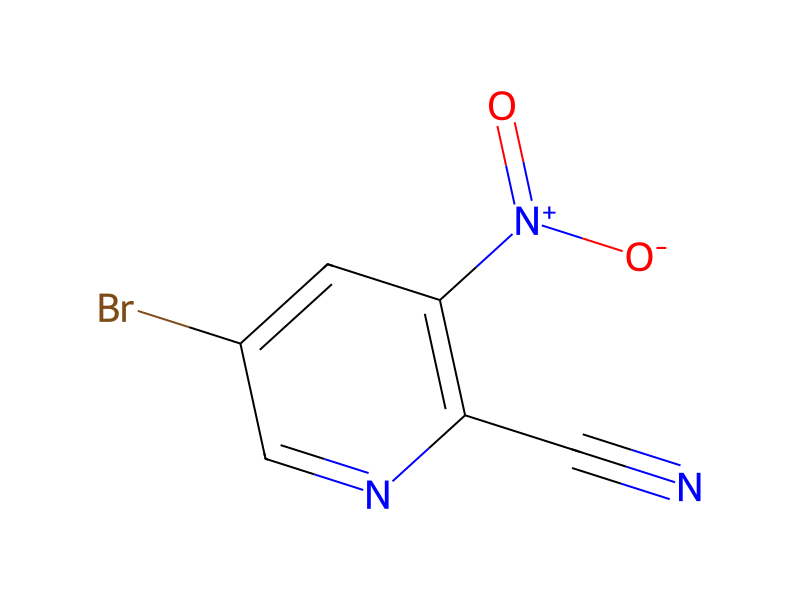
2,5-Dibromo-3-nitropyridine → 5-Bromo-3-nitropyridine-2-carbonitrile
Reaction equation

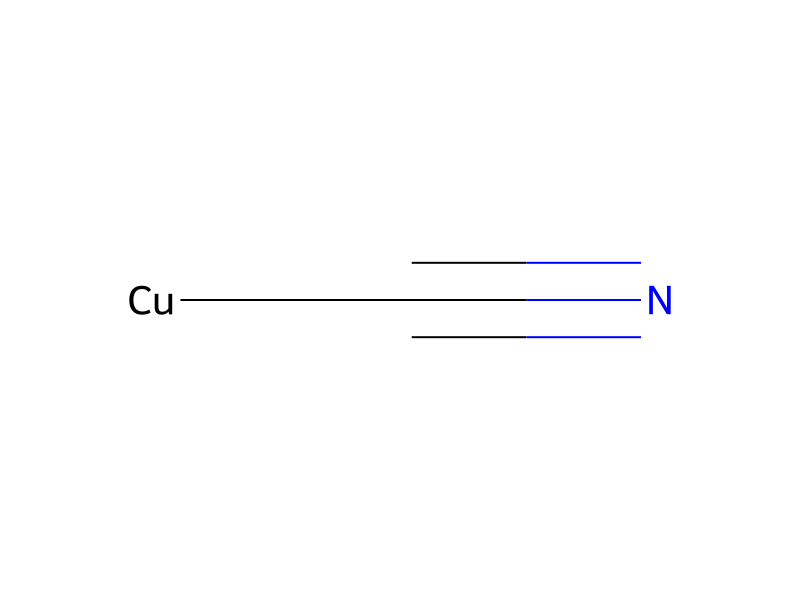
Br[C:2]1[C:7]([N+:8]([O-:10])=[O:9])=[CH:6][C:5]([Br:11])=[CH:4][N:3]=1.[C:12]([Cu])#[N:13]>C(#N)CC.CCOC(C)=O>[Br:11][C:5]1[CH:6]=[C:7]([N+:8]([O-:10])=[O:9])[C:2]([C:12]#[N:13])=[N:3][CH:4]=1Participants
5
Reactant 2

Product 1
Reagents, catalysts & solvents 2


Conditions
- Temperature
- 90 °C
Procedure
To a stirred solution of 2,5-dibromo-3-nitro-pyridine (25 g, 88.68 mmol) in propionitrile (100 ml) was added CuCN (8.7 g, 97.55 mmol) and the mixture was heated to 90° C. for 17 h. Then it was allowed to cool to room temperature, diluted with EtOAc, washed twice with brine, dried with Na2SO4 and concentrated. The remaining residue was purified by chromatography (silica gel; DCM/MeOH 95:5-85:15) to obtain the title compound as yellow solid (17.5 g, 68%).
Workup
- temperatureto cool to room temperature
- washwashed twice with brine
- dry with materialdried with Na2SO4
- concentrationconcentrated
- customThe remaining residue was purified by chromatography (silica gel; DCM/MeOH 95:5-85:15)
Sources & evidence
- ORD record
- ord-cb2040b0e11c4c02980b3ef2596a3d2c
- Source dataset
- uspto-grants-2014_12
- Patent number
- US08912221B2
Reaction notes
Loading…