Diethyl Oxalate → Ethyl 2,3-dioxo-1,2,3,4-tetrahydroquinoxaline-6-carboxylate
Reaction equation

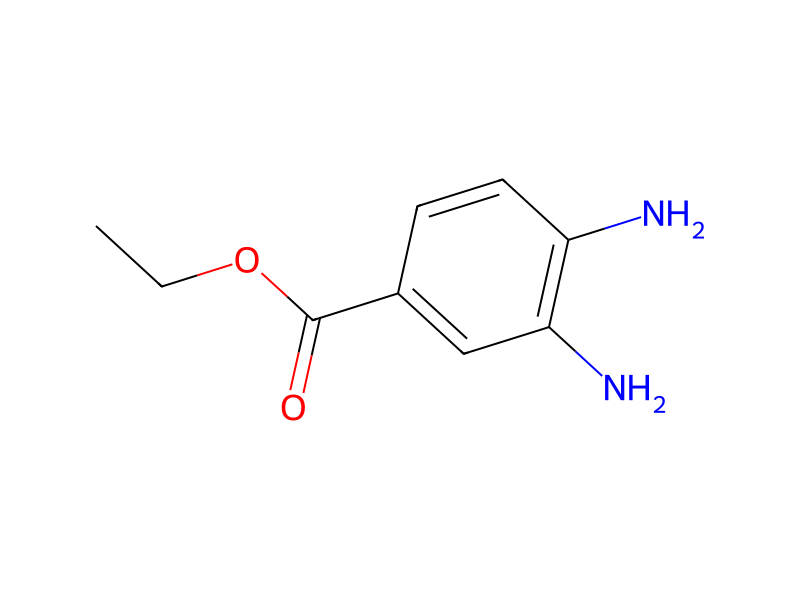
[NH2:1][C:2]1[CH:3]=[C:4]([CH:10]=[CH:11][C:12]=1[NH2:13])[C:5]([O:7][CH2:8][CH3:9])=[O:6].[C:14](OCC)(=[O:20])[C:15](OCC)=[O:16]>>[O:16]=[C:15]1[C:14](=[O:20])[NH:1][C:2]2[C:12](=[CH:11][CH:10]=[C:4]([C:5]([O:7][CH2:8][CH3:9])=[O:6])[CH:3]=2)[NH:13]1Participants
3


Conditions
- Temperature
- 140 °C
Procedure
Into a 250-mL round-bottom flask, was placed a solution of ethyl 3,4-diaminobenzoate (5 g, 27.75 mmol, 1.00 equiv) in diethyl oxalate (100 mL). The resulting solution was stirred overnight at 140° C. in an oil bath. Then the resulting solution was cooled to room temperature. The solids were collected by filtration. The solid was dried in an oven under reduced pressure. This resulted in 3.5 g (54%) of ethyl 2,3-dioxo-1,2,3,4-tetrahydroquinoxaline-6-carboxylate as a brown solid.
Workup
- customInto a 250-mL round-bottom flask, was placed
- temperatureThen the resulting solution was cooled to room temperature
- filtrationThe solids were collected by filtration
- customThe solid was dried in an oven under reduced pressure
- customThis resulted in 3.5 g (54%) of ethyl 2,3-dioxo-1,2,3,4-tetrahydroquinoxaline-6-carboxylate as a brown solid
Sources & evidence
- ORD record
- ord-100a6f63f2a349aea71a91bfad8a52a7
- Source dataset
- uspto-grants-2014_12
- Patent number
- US08916560B2
Reaction notes
Loading…