Iodine → 1-(4-bromo-1H-pyrrol-2-yl)-2,2,2-trichloroethanone
Reaction equation

[Cl:1][C:2]([Cl:11])([Cl:10])[C:3]([C:5]1[NH:6][CH:7]=[CH:8][CH:9]=1)=[O:4].II.[Br:14]Br>C(Cl)(Cl)(Cl)Cl>[Br:14][C:8]1[CH:9]=[C:5]([C:3](=[O:4])[C:2]([Cl:1])([Cl:10])[Cl:11])[NH:6][CH:7]=1Participants
Reactant 3


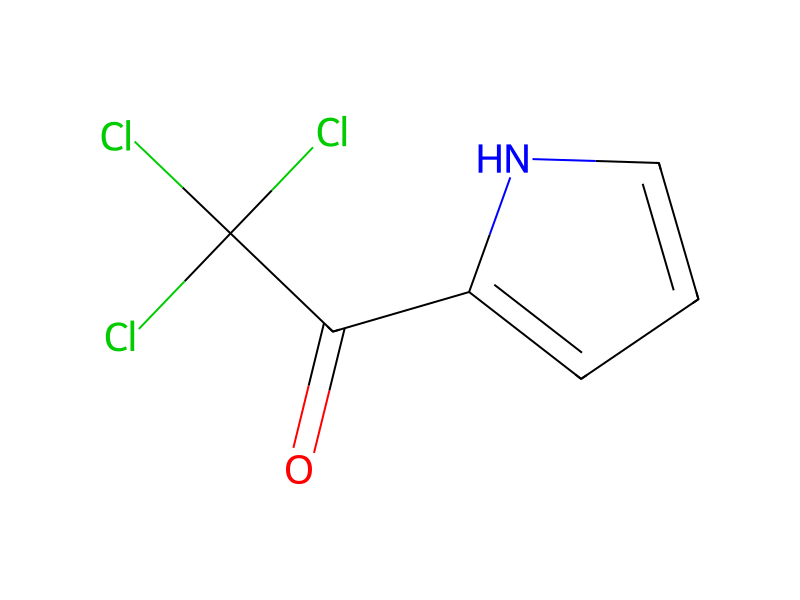
Product 1

Reagents, catalysts & solvents 1

Conditions
- Temperature
- 0 °C
Procedure
To a 100 mL 3-neck round bottom equipped with a dropping funnel was added trichloroacetyl pyrrole (50 g, 236.4 mmol) and CCl4 (1.0 L). After trichloroacetyl pyrrole was dissolved, the reaction was cooled to 0° C. and iodine (0.176 g) was added to the reaction. At this time, a solution of bromine (12 mL) in CCl4 (100 mL) was added dropwise very slowly to the reaction through a dropping funnel over 20 minutes and the resulting mixture was stirred at 0° C. for additional 20 minutes. The resulting mixture was transferred into a separatory funnel and washed with 10% Na2S2O3 solution, saturated NaHCO3 solution and brine (2×). The organic layer was dried and concentrated to give 50 g (60%) of the title compound as a white solid. LCMS (condition A): m/z=287.8, 289.8, 290.8−ve. 1H NMR (400 MHz, CDCl3) δ ppm: 12.8 (1H, br.s), 7.56 (1H, m), 7.33 (1H, m).
Workup
- customTo a 100 mL 3-neck round bottom equipped with a dropping funnel
- customThe resulting mixture was transferred into a separatory funnel
- washwashed with 10% Na2S2O3 solution, saturated NaHCO3 solution and brine (2×)
- customThe organic layer was dried
- concentrationconcentrated
Sources & evidence
- ORD record
- ord-6466aa3eb97f4311abd406e94e26f706
- Source dataset
- uspto-grants-2014_12
- Patent number
- US08921368B2
Reaction notes
Loading…