Pyridine → 4-Nitrophenyl (5-chlorothiazol-2-yl)carbamate
Reaction equation

Cl.[NH2:2][C:3]1[S:4][C:5]([Cl:8])=[CH:6][N:7]=1.N1C=CC=CC=1.Cl[C:16]([O:18][C:19]1[CH:24]=[CH:23][C:22]([N+:25]([O-:27])=[O:26])=[CH:21][CH:20]=1)=[O:17]>C(Cl)Cl>[Cl:8][C:5]1[S:4][C:3]([NH:2][C:16](=[O:17])[O:18][C:19]2[CH:20]=[CH:21][C:22]([N+:25]([O-:27])=[O:26])=[CH:23][CH:24]=2)=[N:7][CH:6]=1Participants
Reactant 3

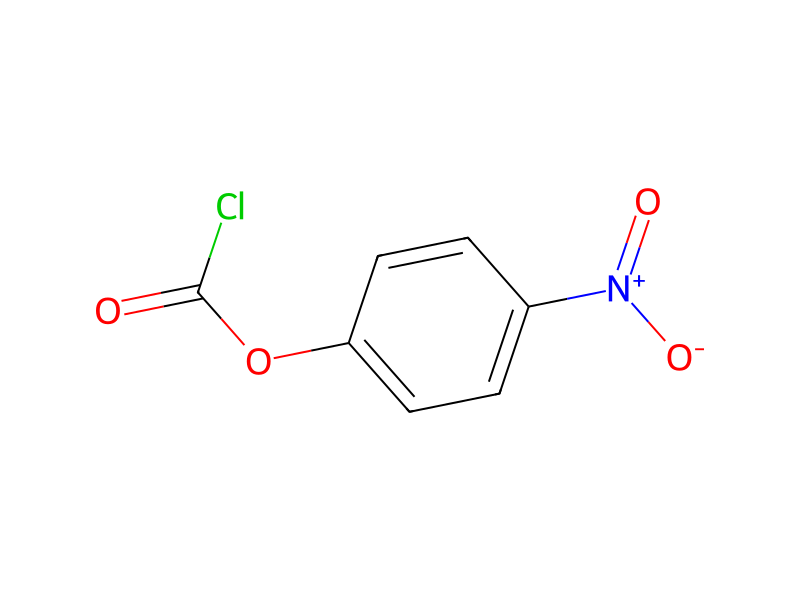

Product 1

Reagents, catalysts & solvents 1

Procedure
2-Amino-5-chlorothiazole hydrochloride (1.00 g, 5.80 mmol) was dissolved in methylene chloride (50 mL), and the obtained solution was then washed with a saturated aqueous solution of sodium hydrogen carbonate. The resulting solution was dried over anhydrous sodium sulfate and was then filtered. After that, pyridine (0.47 mL, 5.80 mmol) and 4-nitrophenyl chloroformate (1.18 g, 5.80 mmol) were added to the filtrate, and the obtained mixture was then stirred at room temperature for 3 hours. Thereafter, a solid was collected by filtration, was then washed with methylene chloride, and was then dried to obtain 4-nitrophenyl (5-chlorothiazol-2-yl)carbamate (980 mg, 56%) in the form of a white solid. t-Butyl 5-bromospiro[indoline-3,3′-pyrrolidine]-1′-carboxylate (65.1 mg, 0.184 mmol) synthesized by a method described in the known method (International Publication WO2009/089454) or a method similar thereto was dissolved in N,N′-dimethylformamide (2 mL). Thereafter, 4-nitrophenyl (5-chlorothiazol-2-yl)carbamate (55.2 mg, 0.184 mmol) and triethylamine (13 μL, 0.092 mmol) were added to the above obtained solution, and the obtained mixture was then stirred at 50° C. for 3 hours. Thereafter, the reaction solution was diluted with water, and was then extracted with ethyl acetate. The organic layer was washed with brine, and was then dried over anhydrous sodium sulfate, followed by concentration in vacuo. The obtained residue was purified by silica gel column chromatography (hexane:ethyl acetate=2:1) to obtain the captioned compound (60.0 mg, 64%) in the form of a white solid.
Workup
- washthe obtained solution was then washed with a saturated aqueous solution of sodium hydrogen carbonate
- dry with materialThe resulting solution was dried over anhydrous sodium sulfate
- filtrationwas then filtered
- filtrationThereafter, a solid was collected by filtration
- washwas then washed with methylene chloride
- customwas then dried
Sources & evidence
- ORD record
- ord-fc7a640bdf7440c889bb7ecdfc7e81d1
- Source dataset
- uspto-grants-2014_12
- Patent number
- US08921576B2
Reaction notes
Loading…