Phosphorus pentachloride → Phosphorus trichloride
Reaction equation

[Cl-:1].[NH4+].[P:3]([Cl:8])([Cl:7])([Cl:6])([Cl:5])[Cl:4]>>[P:3]([Cl:8])([Cl:7])([Cl:6])([Cl:5])[Cl:4].[P:3]([Cl:6])([Cl:5])[Cl:4].[Cl:1][Cl:4]Participants


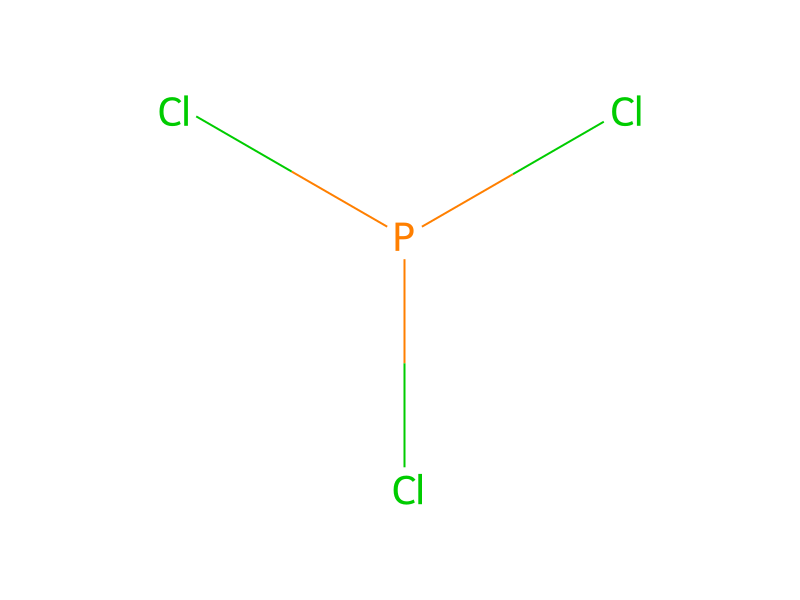

Procedure
This reaction of ammonium chloride and phosphorus pentachloride may be carried out, while producing phosphorus pentachloride from phosphorus trichloride and chlorine. In this case, phosphorus trichloride is employed as the starting material instead of phosphorus pentachloride. Ammonium chloride, phosphorus trichloride and a catalyst are dispersed in an organic solvent inert to chlorine, and then the temperature is raised to 100° to 200° C. and chlorine gas is supplied into the dispersion to start the reaction. The reaction is carried out under reflux with stirring. During the reaction, an approximately equimolar amount of chlorine gas with phosphorus trichloride is supplied at a rate of 0.1 to 1.5 g./minute per mole of phosphorus trichloride to produce phosphorus pentachloride. The resulting phosphorus pentachloride reacts with ammonium chloride to produce the phosphonitrilic chloride oligomers. After the completion of the supply of chlorine gas, the reaction is further continued at a temperature of 100° to 200° C. for 0.5 to 2 hours under reflux with stirring to complete the reaction.
Sources & evidence
- ORD record
- ord-76742d2e9e354578ac9d16e5ab34eb7f
- Source dataset
- uspto-grants-1981_02
- Patent number
- US04248845
Reaction notes
Loading…