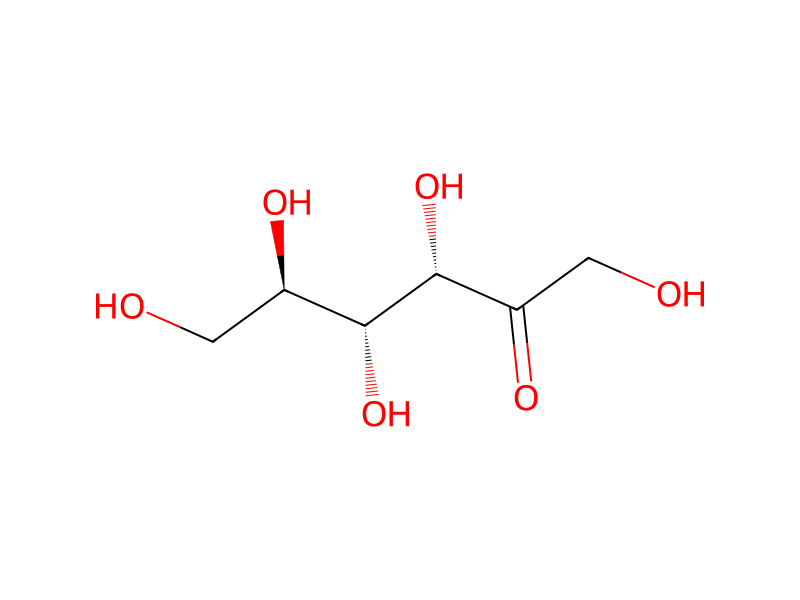
D-(-)-Fructose → (2R,3S,4R,5R)-2,3,4,5,6-pentahydroxyhexanal
Reaction equation

[OH:1][CH2:2][C:3]([C@H:5]([C@@H:7]([C@@H:9]([CH2:11][OH:12])[OH:10])[OH:8])[OH:6])=[O:4].[Mg+2].[Cl-].[Cl-]>>[O:1]=[CH:2][C@@H:3]([C@H:5]([C@@H:7]([C@@H:9]([CH2:11][OH:12])[OH:10])[OH:8])[OH:6])[OH:4]Participants
3


Conditions
- Temperature
- 60 °C
Procedure
The immobilized enzyme composite was then packed in a column and a 45% weight by volume solution of fructose with 5×10⁻³M MgCl2 was passed over the beads while maintaining the temperature at 60° C. for a period of 2 hours. At the end of the 2 hour period the amount of glucose formed and the flow rate were assayed. It was found that the activity of the enzyme was 227 units/gram at a flow rate of 2 ml/min.; the term "unit" being defined as the grams of glucose formed per hour per gram of immobilized enzyme conjugate. In addition, it was found that the coupling efficiency of the conjugate was 54%.
Sources & evidence
- ORD record
- ord-c4557c50585f4bcf89f73b0447c55942
- Source dataset
- uspto-grants-1981_02
- Patent number
- US04250080
Reaction notes
Loading…