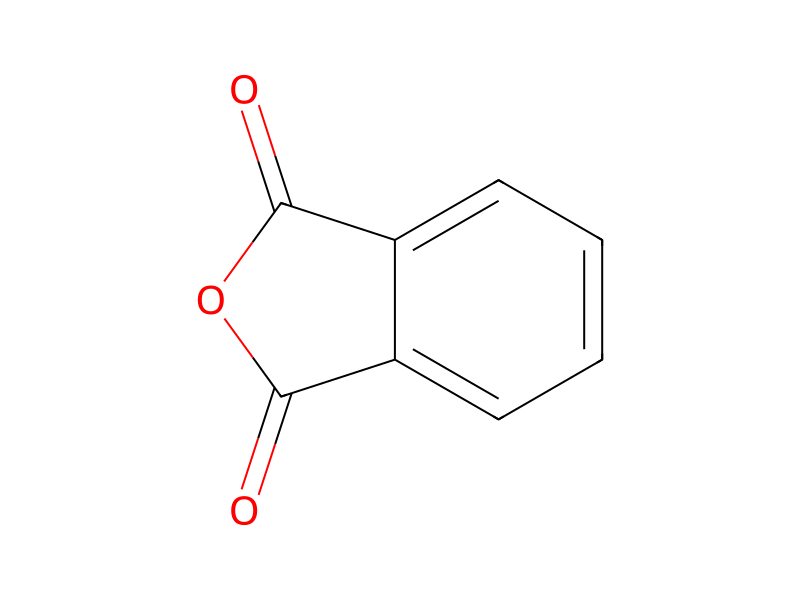
Phthalic Anhydride → HCID 20523556, compound
Reaction equation

[C:1]1(=[O:11])[O:6][C:4](=[O:5])[C:3]2=[CH:7][CH:8]=[CH:9][CH:10]=[C:2]12.[C:12]1([N:18]2[CH:22]=[CH:21][CH:20]=[CH:19]2)[CH:17]=[CH:16][CH:15]=[CH:14][CH:13]=1.[Cl-].[Al+3].[Cl-].[Cl-]>ClC1C=CC=CC=1>[C:12]1([N:18]2[CH:22]=[CH:21][CH:20]=[C:19]2[C:4]([C:3]2[CH:7]=[CH:8][CH:9]=[CH:10][C:2]=2[C:1]([OH:6])=[O:11])=[O:5])[CH:17]=[CH:16][CH:15]=[CH:14][CH:13]=1Participants
5
Reactant 3


Product 1

Reagents, catalysts & solvents 1

Procedure
To a mixture of 2.96 g (0.02 mole) of phthalic anhydride and 5.72 g (0.04 mole) of N-phenylpyrrole in 50 ml of chlorobenzene, maintained at 0°-5° C. in an ice bath, 810 g (0.06 mole) of aluminum chloride was added in small portions. The reaction mixture was held at 0°-5° C. for approximately two hours. The reaction was allowed to warm to room temperature and then set aside overnight at ambient temperature. The reaction mixture was worked up in a manner similar to that described in part A of Example 15 to obtain 2-[(1-phenyl-2-pyrrolyl)carbonyl]benzoic acid (Formula IX: R0 =R1 =R2 =R3 =H; R7 =C6H5) which melted over the range 159°-168° C.
Workup
- temperaturemaintained at 0°-5° C. in an ice bath
- waitset aside overnight at ambient temperature
Sources & evidence
- ORD record
- ord-318d1dce02ab4cfc8c7b6c0fec561281
- Source dataset
- uspto-grants-1981_02
- Patent number
- US04251446
Reaction notes
Loading…