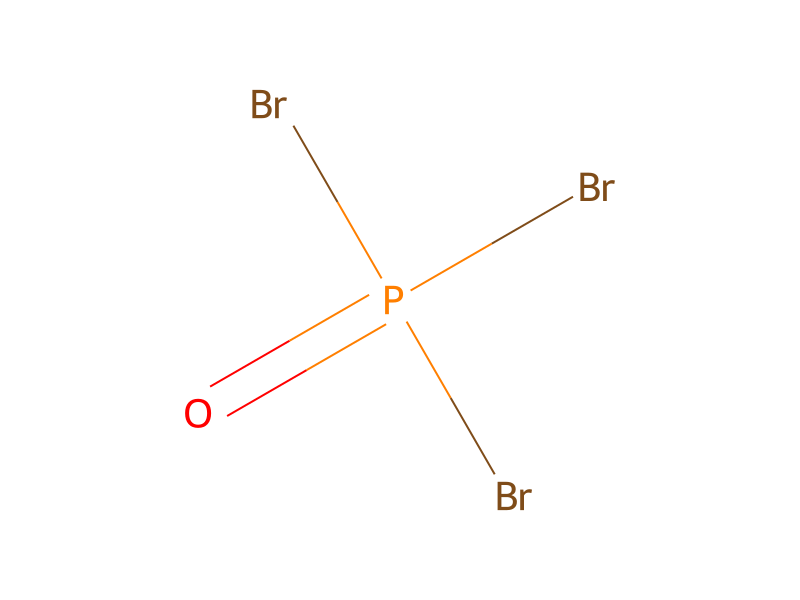
Phosphorus oxybromide → 4-Bromo-2-(trifluoromethyl)quinoline
Reaction equation

[F:1][C:2]([F:15])([F:14])[C:3]1[CH:12]=[C:11](O)[C:10]2[C:5](=[CH:6][CH:7]=[CH:8][CH:9]=2)[N:4]=1.P(Br)(Br)([Br:18])=O>>[F:1][C:2]([F:15])([F:14])[C:3]1[CH:12]=[C:11]([Br:18])[C:10]2[C:5](=[CH:6][CH:7]=[CH:8][CH:9]=2)[N:4]=1Participants


Procedure
2-Trifluoromethyl cinchoninic acid, and substituted 2-trifluoromethyl cinchoninic acids, are known plant growth regulating materials. Such compounds can be prepared, as disclosed by B. M. Pinder and A. Burger (J. Med. Chem, 11, pp 267-269 (1968), by condensation of aniline, or a substituted aniline, with ethyl 4,4,4-trifluoroacetoacetate in the presence of polyphosphoric acid to produce a 2-trifluoromethyl-4-hydroxyquinoline from which the desired 2-trifluoromethyl cinchoninic acid can be obtained by two alternative procedures. In the first of such procedures, the 2-trifluoromethyl-4-hydroxyquinoline is brominated with phosphorus oxybromide to produce the corresponding 2-trifluoromethyl-4-bromoquinoline which is then reacted with n-butyllithium to produce a lithioquinoline which can in turn be treated with dry carbon dioxide to produce the desired 2-trifluoromethyl cinchoninic acid. In the second of such procedures, the 2-trifluoromethyl-4-hydroxyquinoline is chlorinated with phosphorus oxychloride and the resulting 2-trifluoromethyl-4-chloroquinoline is reacted with cuprous cyanide in N-methylpyrrolidone to convert it to the corresponding nitrile which is then hydrolyzed to the desired 2-trifluoromethyl cinchoninic acid. However, not only are both these procedures complex and involved, but they involve the use of corrosive materials such as phosphorus oxybromide and phosphorus oxychloride as well as air- and water-sensitive materials such as butyllithium and copper cyanide.
Workup
- customcan be obtained by two alternative procedures
Sources & evidence
- ORD record
- ord-4845819287b34affa774453507913b24
- Source dataset
- uspto-grants-1981_02
- Patent number
- US04251661
Reaction notes
Loading…