Hexafluoroacetone → 1,1,1,3,3,3-Hexafluoro-2-(1,2,3,4-tetrahydroquinolin-6-yl)propan-2-ol
Reaction equation

[NH:1]1[C:10]2[C:5](=[CH:6][CH:7]=[CH:8][CH:9]=2)[CH2:4][CH2:3][CH2:2]1.[F:11][C:12]([F:20])([F:19])[C:13]([C:15]([F:18])([F:17])[F:16])=[O:14]>[Cl-].[Al+3].[Cl-].[Cl-].C(Cl)Cl>[F:11][C:12]([F:20])([F:19])[C:13]([C:15]([F:18])([F:17])[F:16])([C:7]1[CH:6]=[C:5]2[C:10](=[CH:9][CH:8]=1)[NH:1][CH2:2][CH2:3][CH2:4]2)[OH:14]Participants

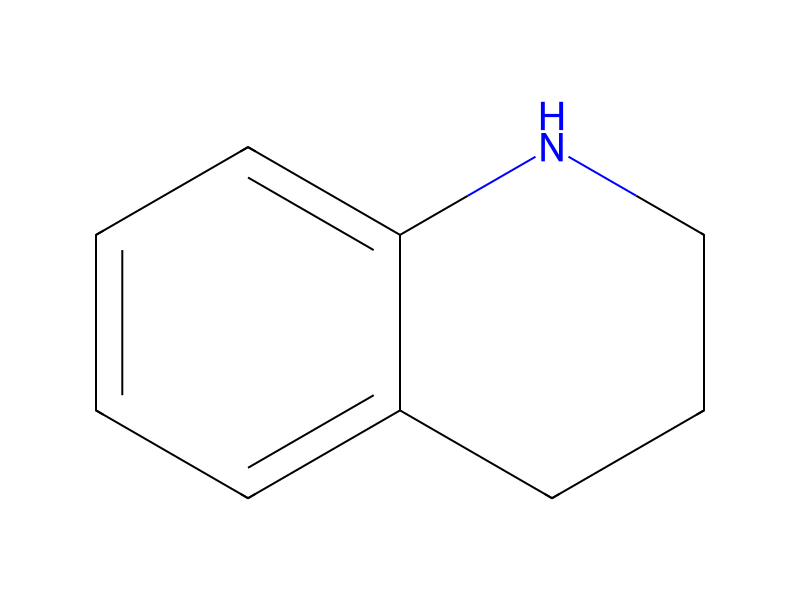



Conditions
- Temperature
- 120 °C
Procedure
Two hundred grams of 1,2,3,4-tetrahydroquinoline and 2 g anhydrous aluminum chloride are added to a one liter stainless steel reactor. The reactor is cooled and evacuated, 265 g (1.60 moles) hexafluoroacetone is added, and it is sealed and heated to 120° C. with shaking for ten hours. The reactor is then cooled to room temperature and vented. The contents are decanted to give a red semicrystalline solid, which is treated with 250 ml of methylene chloride and filtered. The filter cake is washed with three additional 250 ml portions of methylene chloride. The residual orange solid is treated with decolorizing carbon in hot chlorobutane and filtered. From the filtrate is obtained 310 g (1.04 moles) α,α-bis(trifluoromethyl)-1,2,3,4-tetrahydro-6-quinolinemethanol, as a pale yellow crystalline solid, m.p. 115°-116° C.
Workup
- temperatureThe reactor is cooled
- customevacuated
- customit is sealed
- temperatureThe reactor is then cooled to room temperature
- customThe contents are decanted
- customto give a red semicrystalline solid, which
- filtrationfiltered
- washThe filter cake is washed with three additional 250 ml portions of methylene chloride
- additionThe residual orange solid is treated with decolorizing carbon in hot chlorobutane
- filtrationfiltered
Sources & evidence
- ORD record
- ord-3ed6fd0e850748c598e15442cf6d5d92
- Source dataset
- uspto-grants-1981_02
- Patent number
- US04251659
Reaction notes
Loading…