Benzene → Diethyl 2-vinylcyclopropane-1,1-dicarboxylate
Reaction equation

[CH2:1](Cl)/[CH:2]=[CH:3]/[CH2:4]Cl.[C:7]([O:15][CH2:16][CH3:17])(=[O:14])[CH2:8][C:9]([O:11][CH2:12][CH3:13])=[O:10].C1C=CC=CC=1.[OH-].[K+]>O>[CH:2]([CH:3]1[CH2:4][C:8]1([C:9]([O:11][CH2:12][CH3:13])=[O:10])[C:7]([O:15][CH2:16][CH3:17])=[O:14])=[CH2:1]Participants
Reactant 4

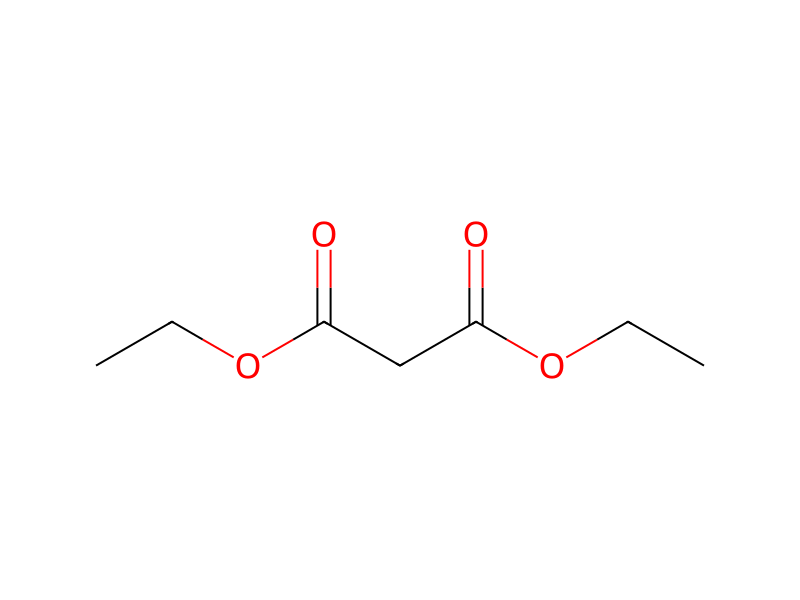


Product 1

Reagents, catalysts & solvents 1

Conditions
- Temperature
- 60 °C
Procedure
To illustrate yet another variation of the present process a reaction vessel fitted with a suitable stirrer, Dean-Stark trap, and condenser was charged with 866 g (6.9 mol) trans 1,4-dichlorobutene-2, 640 g (4.0 mol) diethyl malonate, 1.2 g (0.08 mol percent based on malonate) tricaprylylmethylammonium chloride and 1.8 liters benzene. The reactor and its contents were heated to 60° C. with stirring and incremental additions of flaked solid (85%) potassium hydroxide made over a 4.75-hour period while azeotropically removing water of reaction. A total of 528 grams solid KOH were charged. After 5.5 hours the theoretical amount of water was removed and the reaction mixture was cooled, filtered to remove potassium salts and the benzene solution concentrated. The crude brown oil, upon distillation at reduced pressure, yielded the desired diethyl 2-vinylcyclopropane-1,1-dicarboxylate (65.7% yield).
Workup
- customfitted with a suitable stirrer
- customAfter 5.5 hours the theoretical amount of water was removed
- temperaturethe reaction mixture was cooled
- filtrationfiltered
- customto remove potassium salts
- concentrationthe benzene solution concentrated
- distillationThe crude brown oil, upon distillation at reduced pressure
Sources & evidence
- ORD record
- ord-a5ae8e486ab24734ac473fd094c8d0df
- Source dataset
- uspto-grants-1981_02
- Patent number
- US04252739
Reaction notes
Loading…