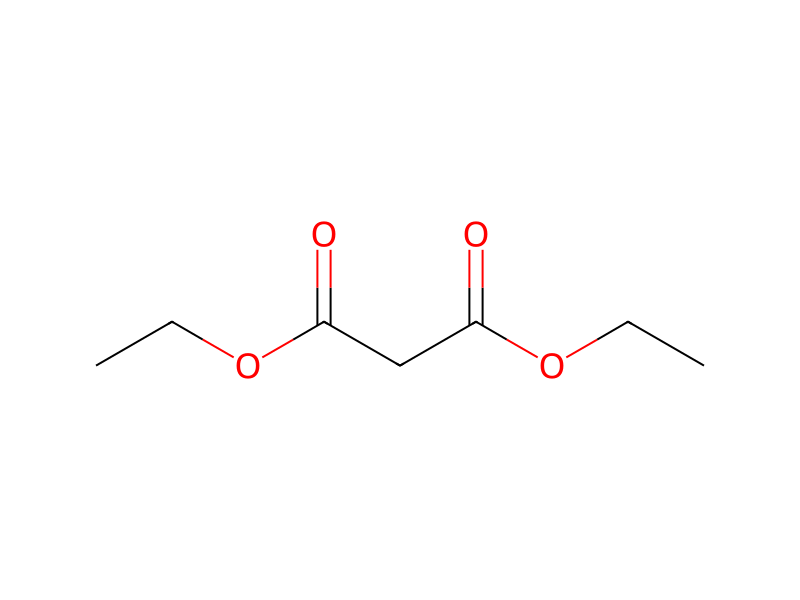
Diethyl Malonate → Diethyl 2-vinylcyclopropane-1,1-dicarboxylate
Reaction equation

[CH2:1](Cl)/[CH:2]=[CH:3]/[CH2:4]Cl.[C:7]([O:15][CH2:16][CH3:17])(=[O:14])[CH2:8][C:9]([O:11][CH2:12][CH3:13])=[O:10].[OH-].[K+]>C(Cl)Cl>[CH:2]([CH:3]1[CH2:4][C:8]1([C:9]([O:11][CH2:12][CH3:13])=[O:10])[C:7]([O:15][CH2:16][CH3:17])=[O:14])=[CH2:1]Participants
Reactant 3


Product 1

Reagents, catalysts & solvents 1

Procedure
The following experiment demonstrates the in situ preparation of the onium compound in the process. In a reaction flask were added 137.5 g (1.1 mol) trans 1,4-dichlorobutene-2, 160.0 g (1.0 mol) diethyl malonate, 600 cc methylene chloride and 6.8 g (5 mol % based on diethyl malonate) N,N-dimethylbenzylamine. The mixture was stirred at ambient temperature for 20 minutes and 124.8 g (2.0 mol) flaked 90% potassium hydroxide then added in small portions over a one-hour period while maintaining the reaction temperature at 25° C. with external cooling. The reaction was then stirred at ambient temperature for four hours. Diethyl 2-vinylcyclopropane-1,1-dicarboxylate (126.6 g; 59.8% yield) was obtained. In a similar manner, 5 mol % tri-n-butylphosphine was employed in the reaction and 69.6% yield diethyl 2-vinylcyclopropane-1,1-dicarboxylate obtained.
Workup
- temperaturewhile maintaining the reaction temperature at 25° C. with external cooling
- stirringThe reaction was then stirred at ambient temperature for four hours
Sources & evidence
- ORD record
- ord-e0b948daac8d4c82b9ab472784f27c99
- Source dataset
- uspto-grants-1981_02
- Patent number
- US04252739
Reaction notes
Loading…