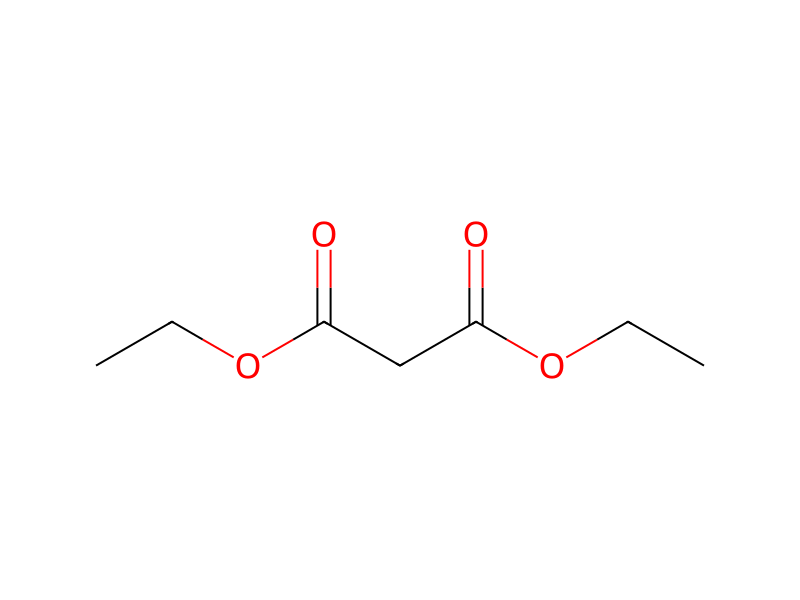
Diethyl Malonate → Diethyl 2-vinylcyclopropane-1,1-dicarboxylate
Reaction equation

[C:1]([O:9][CH2:10][CH3:11])(=[O:8])[CH2:2][C:3]([O:5][CH2:6][CH3:7])=[O:4].[CH2:12](Cl)/[CH:13]=[CH:14]/[CH2:15]Cl.[OH-].[K+]>[Cl-].C(C([NH3+])(C(=O)CCCCCCC)C(=O)CCCCCCC)(=O)CCCCCCC.C(Cl)Cl>[CH:13]([CH:14]1[CH2:15][C:2]1([C:3]([O:5][CH2:6][CH3:7])=[O:4])[C:1]([O:9][CH2:10][CH3:11])=[O:8])=[CH2:12]Participants




Conditions
- Temperature
- 25 °C
Procedure
To demonstrate the ability to vary the method of addition, diethyl malonate (160 g; 1.0 mol) was slowly charged to a reactor with external cooling means containing 137.5 g (1.10 mol) trans 1,4-dichlorobutene-2, 125 g (2.0 mol) flaked KOH (90%), 300 cc methylene chloride and 21 g (5 mol %) of tricaprylylmethylammonium chloride. The reaction mixture was stirred during the addition and temperature maintained at 25° C. with external cooling. At the completion of the reaction the resulting crude product obtained following the usual workup procedure was fractionally distilled and 165.3 g diethyl 2-vinylcyclopropane-1,1-dicarboxylate (77.9% yield) recovered. The reaction was repeated using 1/2 and 1/4 the volume of methylene chloride and yields were 77.4% and 72.3%, respectively. While the reaction does proceed when no solvent is employed, the yield of the diethyl ester product is less than optimum.
Workup
- additionwas slowly charged to a reactor
- temperaturewith external cooling
- customobtained
- distillationwas fractionally distilled
Sources & evidence
- ORD record
- ord-267cc3c872fc42b595b985452f1a6b36
- Source dataset
- uspto-grants-1981_02
- Patent number
- US04252739
Reaction notes
Loading…