Sodium Hydroxide → 2-(1-Piperazinyl)-4-amino-6,7-dimethoxyquinazoline
Reaction equation

Br.[NH:2]1[CH2:7][CH2:6][NH:5][CH2:4][CH2:3]1.[NH2:8][C:9]1[C:18]2[C:13](=[CH:14][C:15]([O:21][CH3:22])=[C:16]([O:19][CH3:20])[CH:17]=2)[N:12]=[C:11](Cl)[N:10]=1.[OH-].[Na+]>COCCO.O>[NH2:8][C:9]1[C:18]2[C:13](=[CH:14][C:15]([O:21][CH3:22])=[C:16]([O:19][CH3:20])[CH:17]=2)[N:12]=[C:11]([N:2]2[CH2:7][CH2:6][NH:5][CH2:4][CH2:3]2)[N:10]=1Participants

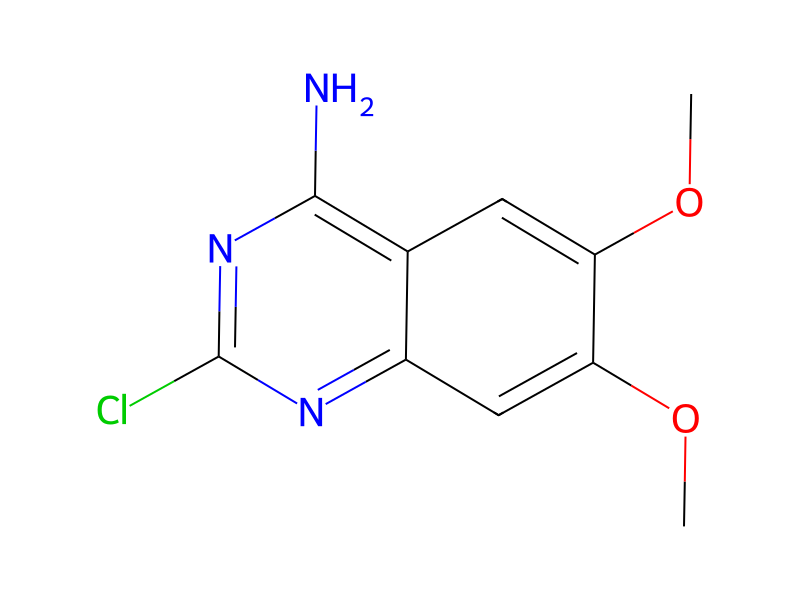




Conditions
- Temperature
- 75 °C
Procedure
Piperazine hydrobromide (168.0 g., 1.006 mole) was added to a suspension of 4-amino-2-chloro-6,7-dimethoxyquinazoline (241.0 g., 1.006 mole) in 2-methoxyethanol (3.6 l.) and the mixture was stirred at reflux for 1.25 hours. The precipitate was separated by filtration, washed with hot 2-methoxyethanol and dried. The material then was added to a stirred solution of sodium hydroxide (81.0 g., 2.01 mole) in water (3 l.) and the mixture was heated to 75° C. The mixture then was cooled to 40° C., filtered, and the insoluble precipitate washed with water and dried. The material was triturated under refluxing absolute ethanol (6.0 l.) and the mixture was filtered. The filtrate was evaporated to dryness to yield the title compound, 180.0 g. (62%), M.P. 224°-228° C.
Workup
- temperatureat reflux for 1.25 hours
- customThe precipitate was separated by filtration
- washwashed with hot 2-methoxyethanol
- customdried
- temperatureThe mixture then was cooled to 40° C.
- filtrationfiltered
- washthe insoluble precipitate washed with water
- customdried
- customThe material was triturated
- temperatureunder refluxing absolute ethanol (6.0 l.)
- filtrationthe mixture was filtered
- customThe filtrate was evaporated to dryness
Sources & evidence
- ORD record
- ord-c8156cdc59b7426ba17db8c58dbc4bca
- Source dataset
- uspto-grants-1977_01
- Patent number
- US04001238
Reaction notes
Loading…