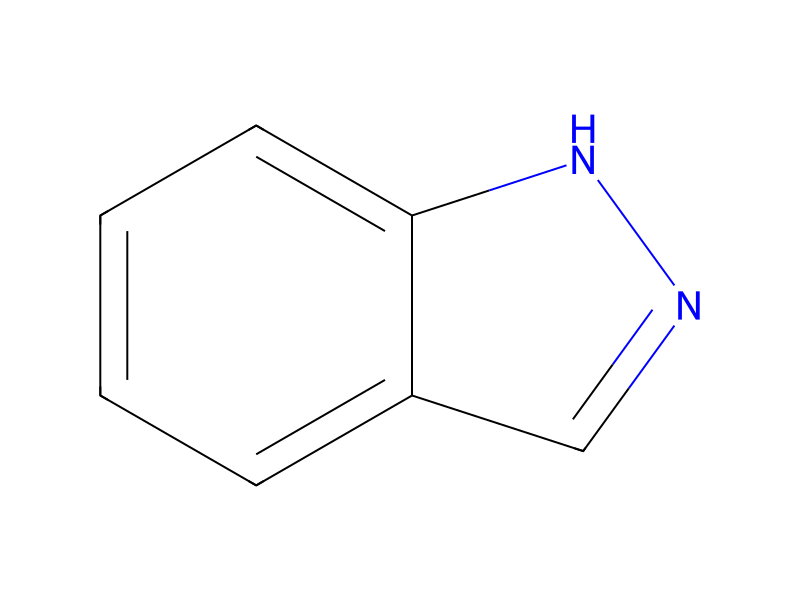
Acetic Acid → 1H-Indazole
Reaction equation

[N:1]([C:4]1[C:9]([CH:10]=O)=[CH:8][C:7](OC)=[C:6](OC)[CH:5]=1)=[N+:2]=[N-].NC1C=CC=CC=1.C(O)(=O)C>CN(C)C=O>[NH:1]1[C:4]2[C:9](=[CH:8][CH:7]=[CH:6][CH:5]=2)[CH:10]=[N:2]1Participants
5
Reactant 3



Product 1
Reagents, catalysts & solvents 1

Procedure
A solution containing 51.8 g (0.25 mole) 6-azidoveratraldehyde (Example XII). 26.0 g (0.28 mole) aniline, 4 ml galcial acetic acid, and 300 ml dimethylformamide was stirred at 90°-100° for 1 hr, then refluxed for 1 hr until the gaseous evolution was complete. After the mixture was cooled and poured slowly in 1.5 l. iced water, the product was filtered, washed with two 150 ml portions cold water, and air dried to give 50 g of crude indazole, m.p. 130°-138°. Recrystallization from ethyl acetate--hexane followed by ethyl acetate gave 26 g (41%) of the product, m.p. 149°-152°. Recrystallization from ethyl acetate--hexane gave the analytical sample, m.p. 149°-152°.
Workup
- temperaturerefluxed for 1 hr until the gaseous evolution
- temperatureAfter the mixture was cooled
- additionpoured slowly in 1.5 l
- filtrationiced water, the product was filtered
- washwashed with two 150 ml portions cold water, and air
- customdried
Sources & evidence
- ORD record
- ord-d78d9a25f43f47ad8247b5119df22454
- Source dataset
- uspto-grants-1977_01
- Patent number
- US04002652
Reaction notes
Loading…