3-Chlorobenzoic Acid → 3-Chlorobenzoic Acid
Reaction equation

[CH2:1]1[CH2:6][CH2:5][CH2:4]C[CH:2]1[C:7]([CH2:9][CH2:10][C:11]#[N:12])=[O:8].ClC1C=CC=C(C(OO)=[O:21])C=1.[Cl:24][C:25]1[CH:26]=[C:27]([CH:31]=[CH:32][CH:33]=1)[C:28]([OH:30])=[O:29]>CCCCCC>[C:11]([CH2:10][CH2:9][CH:7]1[O:8][C:4](=[O:21])[CH2:5][CH2:6][CH2:1][CH2:2]1)#[N:12].[Cl:24][C:25]1[CH:26]=[C:27]([CH:31]=[CH:32][CH:33]=1)[C:28]([OH:30])=[O:29]Participants
Reactant 3
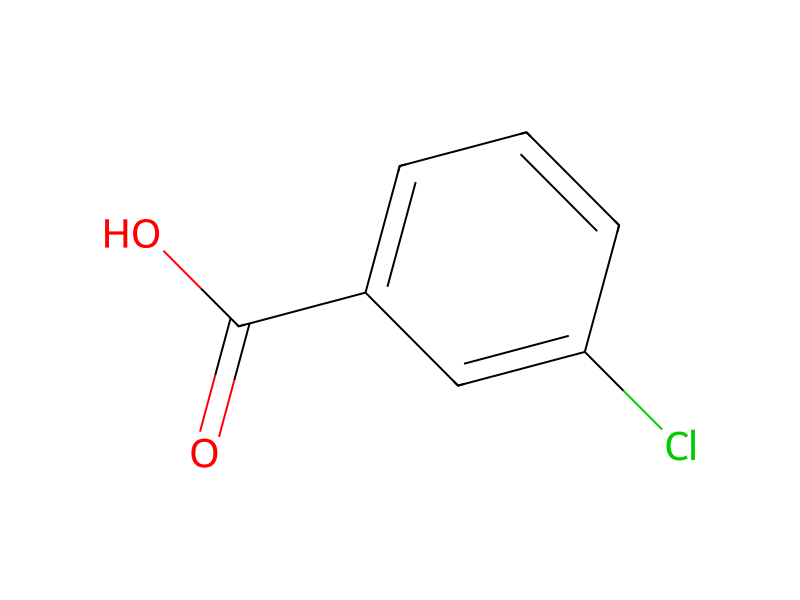


Product 2

Reagents, catalysts & solvents 1

Conditions
- Temperature
- 55 °C
Procedure
A reactor is loaded with 151 g of 3-(2-cyclohexanoyl)propionitrile in 500 ml of n-hexane and 260 g of m-chloroperbenzoic acid (70% titer) dissolved at 50° C. in 2000 ml of n-hexane in 30 minutes. The solution is heated to 55° C. for 15 hours. Cooling of the solution separates, in crystalline form, part of the m-chlorobenzoic acid which is scarcely soluble in the system, together with a heavy liquid phase which is formed by 7-cyanoethyl-2-oxepanone and by m-chlorobenzoic acid. 71.5 g of 7-cyanoethyl-2-oxepanone, impure with m-chlorobenzoic acid, are recovered from the lower phase. 24 g of 7-cyanoethyl-2-oxepanone are recovered from the upper phase by concentration and several crystallizations. Conversion over the initial ketone is 85%. Yield on the converted amount is 57%.
Sources & evidence
- ORD record
- ord-bef985907b51471ea9071e1de31b2991
- Source dataset
- uspto-grants-1999_06
- Patent number
- US05917067
Reaction notes
Loading…