Cesium carbonate → HCID 15380427, compound
Reaction equation

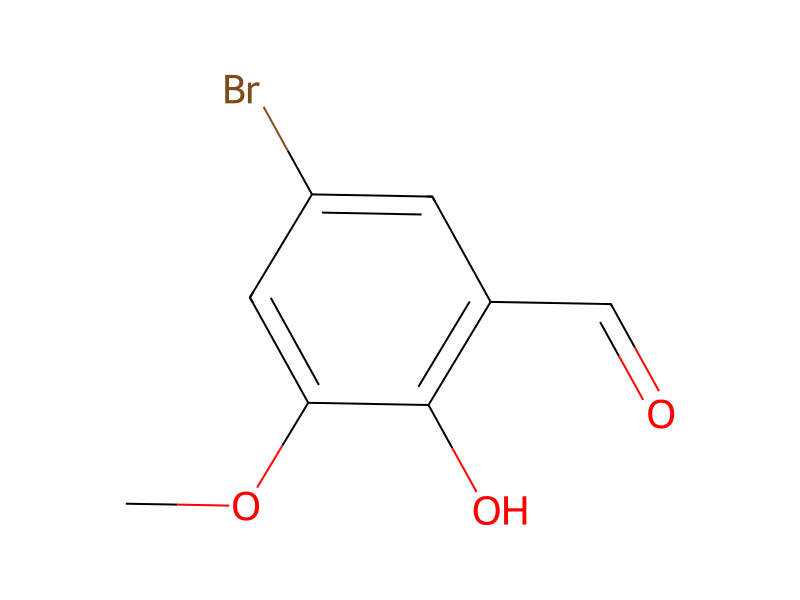
[Br:1][C:2]1[CH:3]=[C:4]([O:11][CH3:12])[C:5]([OH:10])=[C:6]([CH:9]=1)[CH:7]=[O:8].Br[CH2:14][CH:15]([O:18][CH3:19])[O:16][CH3:17].C(=O)([O-])[O-].[Cs+].[Cs+]>CN(C)C=O.ClCCl>[Br:1][C:2]1[CH:3]=[C:4]([O:11][CH3:12])[C:5]([O:10][CH2:14][CH:15]([O:18][CH3:19])[O:16][CH3:17])=[C:6]([CH:9]=1)[CH:7]=[O:8]Participants





Procedure
A heterogeneous solution of 31 g (0.134 mol) of 5-bromo-2-hydroxy-3-methoxybenzaldehyde, 28 g (0.166 mol) of 2-bromo-1,1-dimethoxyethane and 49 g (0.150 mol) of caesium carbonate in 150 ml of dimethylformamide is heated at 160° C. for 3 hours. After returning to room temperature, the mixture is filtered. The filtrate is then evaporated under reduced pressure. The solid so obtained is taken up in 250 ml of dichloromethane and filtered again. The homogeneous solution is then washed twice with 200 ml of 0.1N hydrochloric acid each time and subsequently with 200 ml of a saturated sodium chloride solution. The organic phase is then dried over sodium sulphate and subsequently evaporated under reduced pressure, yielding the expected product.
Workup
- customAfter returning to room temperature
- filtrationthe mixture is filtered
- customThe filtrate is then evaporated under reduced pressure
- customThe solid so obtained
- filtrationfiltered again
- washThe homogeneous solution is then washed twice with 200 ml of 0.1N hydrochloric acid each time
- dry with materialThe organic phase is then dried over sodium sulphate
- customsubsequently evaporated under reduced pressure
Sources & evidence
- ORD record
- ord-70a8c6b09a2842749a61a781d16a7097
- Source dataset
- uspto-grants-1999_03
- Patent number
- US05877190
Reaction notes
Loading…