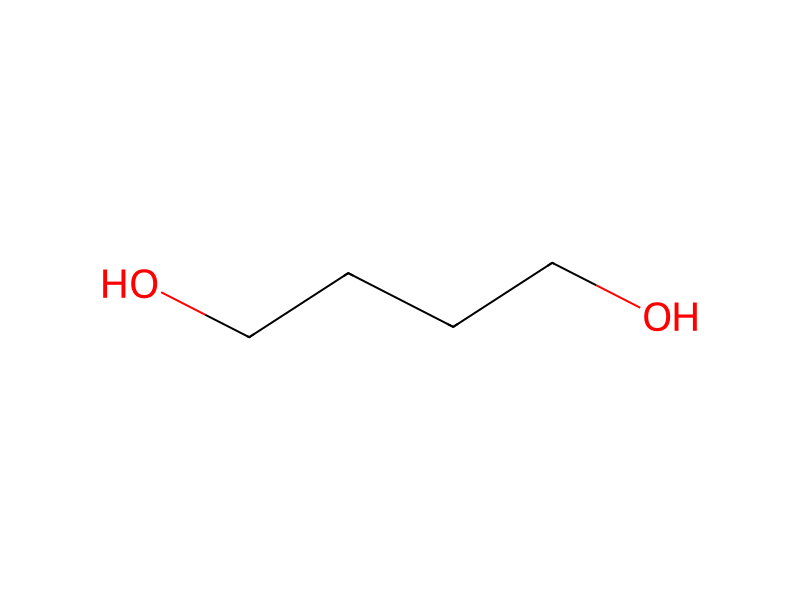
Tetrahydro-2-hydroxyfuran → 1,4-Butanediol
Reaction equation

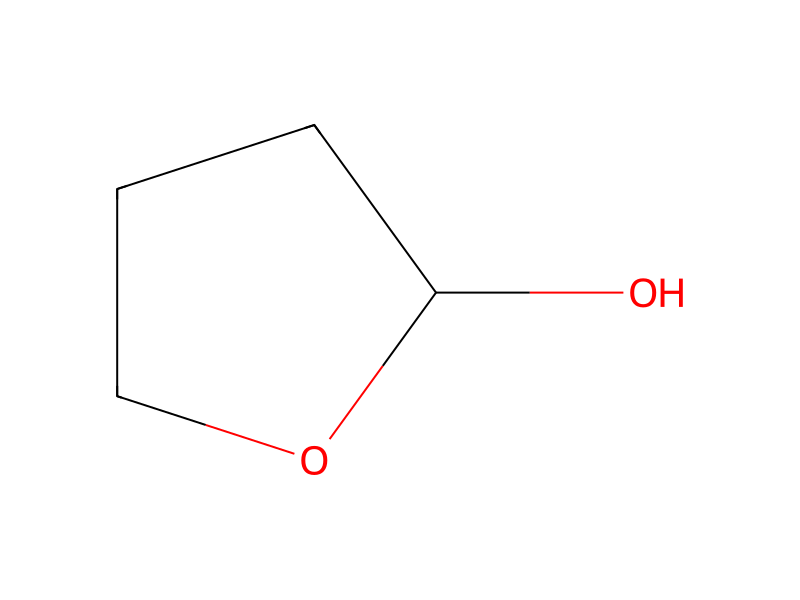
[OH:1][CH2:2][CH2:3][CH2:4][CH:5]=[O:6].OC1CCCO1.[CH3:13][CH:14]([CH2:17][OH:18])[CH:15]=[O:16].[H][H]>O>[CH2:5]([OH:6])[CH2:4][CH2:3][CH2:2][OH:1].[CH3:13][CH:14]([CH2:17][OH:18])[CH2:15][OH:16]Participants



Procedure
420 ml of the solution containing 4-hydroxy-butanal, 2-hydroxy-tetrahydrofuran, and 2-methyl-3-hydroxypropanal was charged to a stainless jacket-stirring reactor equipped with a metal powder-sintered filtering core followed by adding 9.38 g of the thus-obtained hydrogenation catalyst (65% of which has a granularity less than 50 μm). A temperature in the reactor was controlled at 115° C. and a pressure in the reactor was maintained at 60 kg/cm2G by the supply of hydrogen to effect hydrogenation for 2 hours under stirring. After the supply of hydrogen was cut off, the stirring was stopped and the solution was set still for 30 minutes to precipitate the catalyst. The solution was filtrated via the filtering core by the hydrogen pressure in the reactor, then about 400 ml of the top layer of the solution was removed and analyzed by gas chromatograph to obtain a result of 16.64 wt % of 1,4-butanediol, 3.25 wt % of 2-methyl-1,3-propanediol, 80.11 wt % of other reactants and water. Another 400 ml aqueous solution of 4-hydroxy-butanal, 2-hydroxy-tetrahydrofuran, and 2-methyl-3-hydroxypropanal was then added to the reactor and subjected to hydrogenation for 2 hours under the same condition. This process was repeated for 50 batches. The conversion thereof was maintained consistently at about 95-98%, which was calculated by the results obtained from gas chromatograph (GC) according to the following equation: ##EQU1## wherein HBA1 represents the concentration of the solution of 4-hydroxy-butanal, 2-hydroxy-tetrahydrofuran, and 2-methyl-3-hydroxypropanal obtained ma GC analysis before hydrogenation; and
Workup
- additionwas charged to a stainless jacket-stirring reactor
- customequipped with a metal powder-sintered filtering core
- additionby adding 9.38 g of the thus-obtained hydrogenation catalyst (65% of which
- customwas controlled at 115° C.
- customfor 2 hours
- customto precipitate the catalyst
- filtrationThe solution was filtrated via the filtering core by the hydrogen pressure in the reactor
- customabout 400 ml of the top layer of the solution was removed
- customto obtain
Sources & evidence
- ORD record
- ord-8db2e3d2c9414fa6a9fe360d96b775e6
- Source dataset
- uspto-grants-1999_03
- Patent number
- US05888923
Reaction notes
Loading…