Isopropanol → 4-(2-Hydroxy-1,1,1-trifluoro-2-propyl)cyclohexanone
Reaction equation

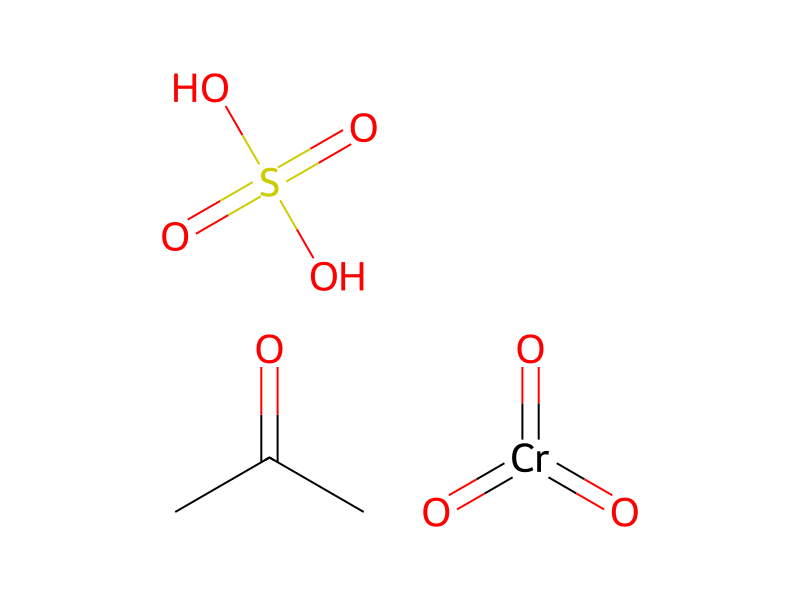
[OH:1][C:2]([CH:8]1[CH2:13][CH2:12][CH:11]([OH:14])[CH2:10][CH2:9]1)([CH3:7])[C:3]([F:6])([F:5])[F:4].CC(C)=O.OS(O)(=O)=O.O=[Cr](=O)=O.C(O)(C)C.C(=O)(O)[O-].[Na+]>CC(C)=O.O>[OH:1][C:2]([CH:8]1[CH2:13][CH2:12][C:11](=[O:14])[CH2:10][CH2:9]1)([CH3:7])[C:3]([F:5])([F:6])[F:4]Participants
7






Procedure
18.8 g (0.089 mol) of 4-(2-hydroxy-1,1,1-trifluoro-2-propyl)cyclohexanol were placed in a mixture of 350 ml of acetone and 20 ml of water, and 50 ml of Jones' reagent were added dropwise at from 10° to 15° C. The mixture was subsequently stirred at room temperature for 1 hour, 10 ml of isopropanol were added, and after a further 30 minutes the mixture was neutralized with 40 g of sodium bicarbonate. It was then filtered, the filtrate was concentrated and the residue was taken up with water/diethyl ether. After drying and concentration of the organic phase, 11.1 g (59.6% of theory) remained of a colorless product.
Workup
- additionwere added dropwise at from 10° to 15° C
- filtrationIt was then filtered
- concentrationthe filtrate was concentrated
- customAfter drying
Sources & evidence
- ORD record
- ord-24af8181729d4a4489a6fb8ab09eeeed
- Source dataset
- uspto-grants-1999_03
- Patent number
- US05889012
Reaction notes
Loading…