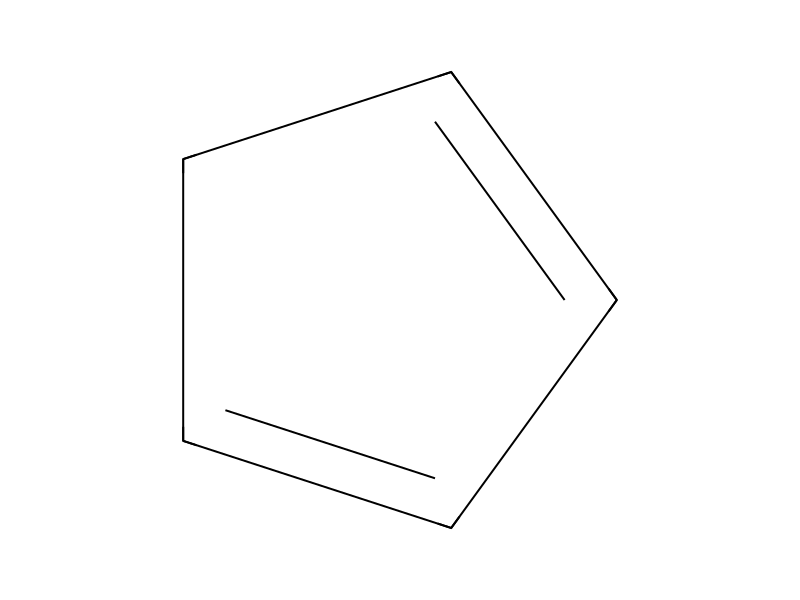
Cyclopentadiene → HCID 131721844, compound
Reaction equation

[OH-].[Na+].[CH:3]1[CH2:7][CH:6]=[CH:5][CH:4]=1.[CH:8]1(Br)[CH2:13][CH2:12][CH2:11][CH2:10][CH2:9]1>CCCCCCCC[N+](CCCCCCCC)(CCCCCCCC)C.[Cl-].O>[CH:8]1([C:4]2([CH:8]3[CH2:13][CH2:12][CH2:11][CH2:10][CH2:9]3)[CH:3]=[CH:7][CH:6]=[CH:5]2)[CH2:13][CH2:12][CH2:11][CH2:10][CH2:9]1Participants
Reactant 3


Product 1

Reagents, catalysts & solvents 2


Conditions
- Temperature
- 8 °C
Procedure
A double-walled reactor having a volume of 1 L, provided with baffles, condenser, top stirrer, thermometer and dropping funnel, was charged with 600 g of clear 50% strength NaOH (7.5 mol), followed by cooling to 8° C. Then 20 g of Aliquat 336 (49 mmol) and 33 g (0.5 mol) of freshly cracked cyclopentadiene were added. The reaction mixture was stirred vigorously for a few minutes, then 172 g of cyclohexyl bromide (1.05 mol) were added. The reaction mixture was then cooled with circulating water at 10° C. After two hours of stirring at room temperature, the reaction mixture was heated to 70° C., followed by a further 6 hours of stirring. GC was used to show that 79% of the mixture of mono-, di- and tri-(cyclohexyl)cyclopentadiene was disubstituted cyclopentadiene. The product was distilled at 0.04 mbar and 110-120° C. After distillation, 73.6 g of di(cyclohexyl)cyclopentadiene were obtained, which was characterized with GC, GC-MS, 13C- and 1H-NMR.
Workup
- customA double-walled reactor having
- customa volume of 1 L, provided with baffles, condenser, top stirrer
- stirringAfter two hours of stirring at room temperature
- temperaturethe reaction mixture was heated to 70° C.
- stirringof stirring
- distillationThe product was distilled at 0.04 mbar and 110-120° C
- distillationAfter distillation
Sources & evidence
- ORD record
- ord-cf16c513b06f424fa86e1ed859fba812
- Source dataset
- uspto-grants-2000_06
- Patent number
- US06072067
Reaction notes
Loading…