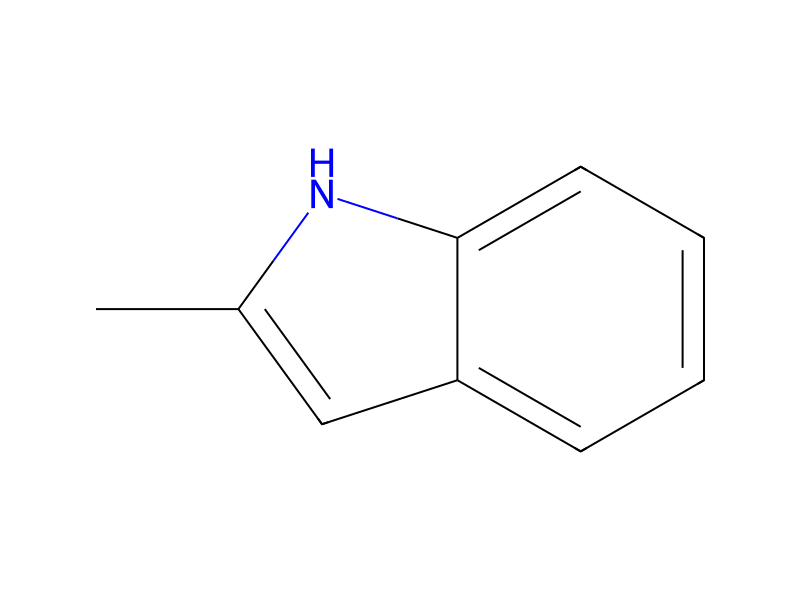
2-Methylindole → 1H-Pyrrole-2,5-dione, 3,4-bis(2-methyl-1H-indol-3-yl)-
Reaction equation

[CH3:1][C:2]1[NH:3][C:4]2[C:9]([CH:10]=1)=[CH:8][CH:7]=[CH:6][CH:5]=2.C[Mg]I.Br[C:15]1[C:20](=[O:21])[NH:19][C:17](=[O:18])[C:16]=1Br>C1C=CC=CC=1.C(OCC)C>[CH3:1][C:2]1[NH:3][C:4]2[C:9]([C:10]=1[C:16]1[C:17](=[O:18])[NH:19][C:20](=[O:21])[C:15]=1[C:10]1[C:9]3[C:4](=[CH:5][CH:6]=[CH:7][CH:8]=3)[NH:3][C:2]=1[CH3:1])=[CH:8][CH:7]=[CH:6][CH:5]=2Participants
6



Procedure
A solution of 4.12 g of 2-methylindole in 75 ml of benzene was treated with 9.2 ml of a 3M solution of methylmagnesium iodide in diethyl ether and the resulting solution was stirred under nitrogen for 0.5 hour. 2.0 g of dibromomaleimide were added and the mixture was heated to reflux for 14 hours. The cooled mixture was evaporated, dissolved in 200 ml of dichloromethane and acidified with 100 ml of 2M hydrochloric acid. The organic layer was separated, washed with 100 ml of water, dried and evaporated. The residue was triturated with dichloromethane and the obtained solid was recrystallized from acetone/water to give 1.1 g of 3,4-bis(2-methyl-3-indolyl)-1H-pyrrole-2,5-dione, m.p. 311°-313° C.
Workup
- temperaturethe mixture was heated
- temperatureto reflux for 14 hours
- customThe cooled mixture was evaporated
- dissolutiondissolved in 200 ml of dichloromethane
- customThe organic layer was separated
- washwashed with 100 ml of water
- customdried
- customevaporated
- customThe residue was triturated with dichloromethane
- customthe obtained solid was recrystallized from acetone/water
Sources & evidence
- ORD record
- ord-248f33a3c4dd4137aac95d5efc2b4df7
- Source dataset
- uspto-grants-2000_06
- Patent number
- USRE036736
Reaction notes
Loading…