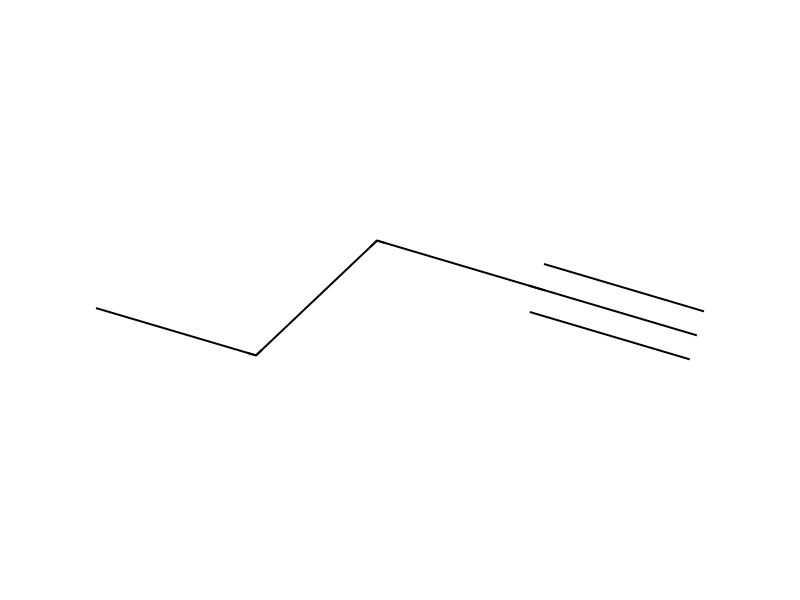
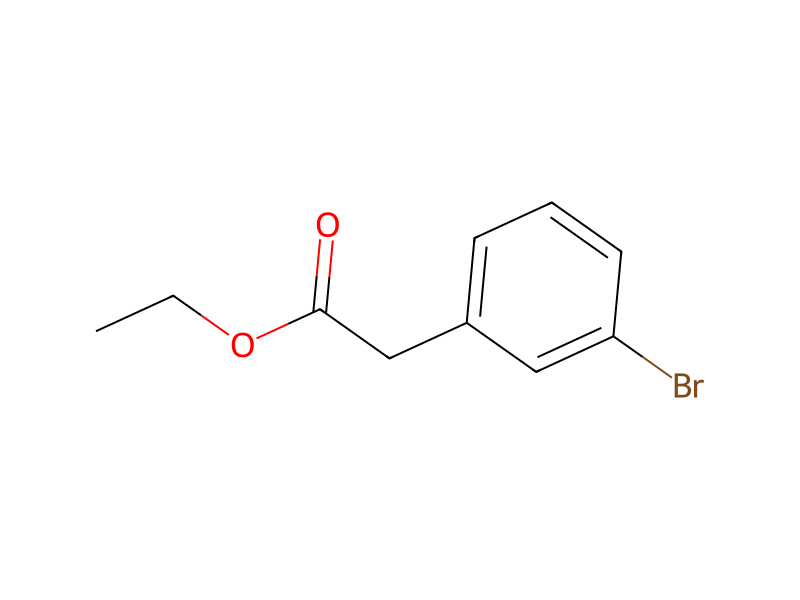
1-Pentyne → Ethyl (3-(pentyne-1-yl)phenyl)acetate
Reaction equation

Br[C:2]1[CH:3]=[C:4]([CH2:8][C:9]([O:11][CH2:12][CH3:13])=[O:10])[CH:5]=[CH:6][CH:7]=1.O.[F-].C([N+](CCCC)(CCCC)CCCC)CCC.[CH:33]#[C:34][CH2:35][CH2:36][CH3:37]>Cl[Pd](Cl)([P](C1C=CC=CC=1)(C1C=CC=CC=1)C1C=CC=CC=1)[P](C1C=CC=CC=1)(C1C=CC=CC=1)C1C=CC=CC=1.O>[C:33]([C:2]1[CH:3]=[C:4]([CH2:8][C:9]([O:11][CH2:12][CH3:13])=[O:10])[CH:5]=[CH:6][CH:7]=1)#[C:34][CH2:35][CH2:36][CH3:37]Participants
6
Reactant 3

Product 1

Reagents, catalysts & solvents 2


Conditions
- Temperature
- 80 °C
Procedure
A mixture of ethyl (3-bromophenyl)acetate (0.3 g, 1.24 mmol) and tetrabutylammonium fluoride hydrate (0.97 g, 3.72 mmol), was treated with PdCl2(PPh3)2 (26 mg, 0.037 mmol; 3 mole %) and 1-pentyne (367 372 mmol) in a sealed tube. The tube was heated at 80° C. for 2 h. The mixture was treated with water, and was extracted with diethyl ether. The organic extract was dried over sodium sulfate, filtered and evaporated in vacuo to give the crude product. Purification on a Biotage™ 25M column (silica), eluting with ethyl acetate/hexane 0:1 to 2:98, gave ethyl (3-(pentyne-1-yl)phenyl)acetate as a pale yellow oil (0.23 g, 79%).
Workup
- extractionwas extracted with diethyl ether
- extractionThe organic extract
- dry with materialwas dried over sodium sulfate
- filtrationfiltered
- customevaporated in vacuo
- customto give the crude product
- customPurification on a Biotage™ 25M column (silica)
- washeluting with ethyl acetate/hexane 0:1 to 2:98
Sources & evidence
- ORD record
- ord-ab38326c267a437191510fa68a12f04e
- Source dataset
- uspto-grants-2015_01
- Patent number
- US08927765B2
Reaction notes
Loading…